Showing posts with label revision. Show all posts

Sunday, 15 October 2023

It’s all ‘bout that quote, ‘bout that quote, no ideas!

Quotation learning is a poor proxy for literature revision. There, I’ve said it. The problem I have with it is that a quotation can only get you so far with exploration of a text. In fact, it stops the flow of thought and ideas. Students mould the thinking to the quotation rather than the quotation to the thinking. 

Over the years, I have seen quotations, plot (I take no prisoners on this one) and context become the juggernauts of revision. Students feel confident if they know some quotations, they know the plot and they can throw in some contextual facts into an essay. In fact, they have become the markers for revision. But, this is where the rub comes, they generate a level of false confidence. They give the appearance of knowing the text well, when that isn’t the case. 


Revision in English has become very knowledge led. But, the knowledge is limited to quite a narrow field. The knowledge of quotations. The knowledge of plot. The knowledge of context. If we are honest, these are the easiest bits of knowledge related to our subject. They are the things we can easily teach, text, and repeat in lessons. This ‘easy’ knowledge spills into how students revise. They revise these ‘easy’ knowledge elements and because they are more concrete than other types of knowledge there’s a sense of accomplishment. Students feel a sense of achievement in a largely abstract subject because they have learnt something concrete. Teachers feel a sense of accomplishment because they have taught something tangible and concrete - and easily measurable. 


There is some value in learning quotations, plot and context, but in the English classroom these should not be the drivers. Sadly, they are, which in turn converts to the idea that in English, all you need to revise is quotations, plot details and contextual facts. They are foundational things rather than exploratory and cumulative things. If you don’t believe me, then check out the examiner’s reports. I have yet to see one that says that students need to learn quotations. 


The knowledge of ideas. The knowledge of concepts. The knowledge of the writers’ feelings and thoughts. These are generally left behind with this concrete knowledge revision focus. We don’t see revision built around these. The complexity of the subject is the main reason. The plurality of ideas means that you cannot easily mark these sorts of things. You cannot easily tick or cross them. You cannot boil them down to a quick true or false task. You cannot summarise them easily. We don’t factor this complexity into revision and so revision doesn’t focus on the complex. Yet, what we expect students to do is get these complex ideas naturally armed with quotations, plot details and contextual knowledge. 


For this reason, I’ve been playing around with revision with our Year 11s. They are preparing for their first mock in November and I thought I’d explore different ways to build and develop a level of complexity in the revision. So, each Friday, we set the first ten minutes on answering these questions about a character studied. Not a quotation really in sight. 


I wanted them to think big and exploratory but also think like they would under exam conditions. They aren’t writing in full sentences, but bullet points. Then, I reveal what I would reward on an online version of the document.  The idea is to score as many points as you can.
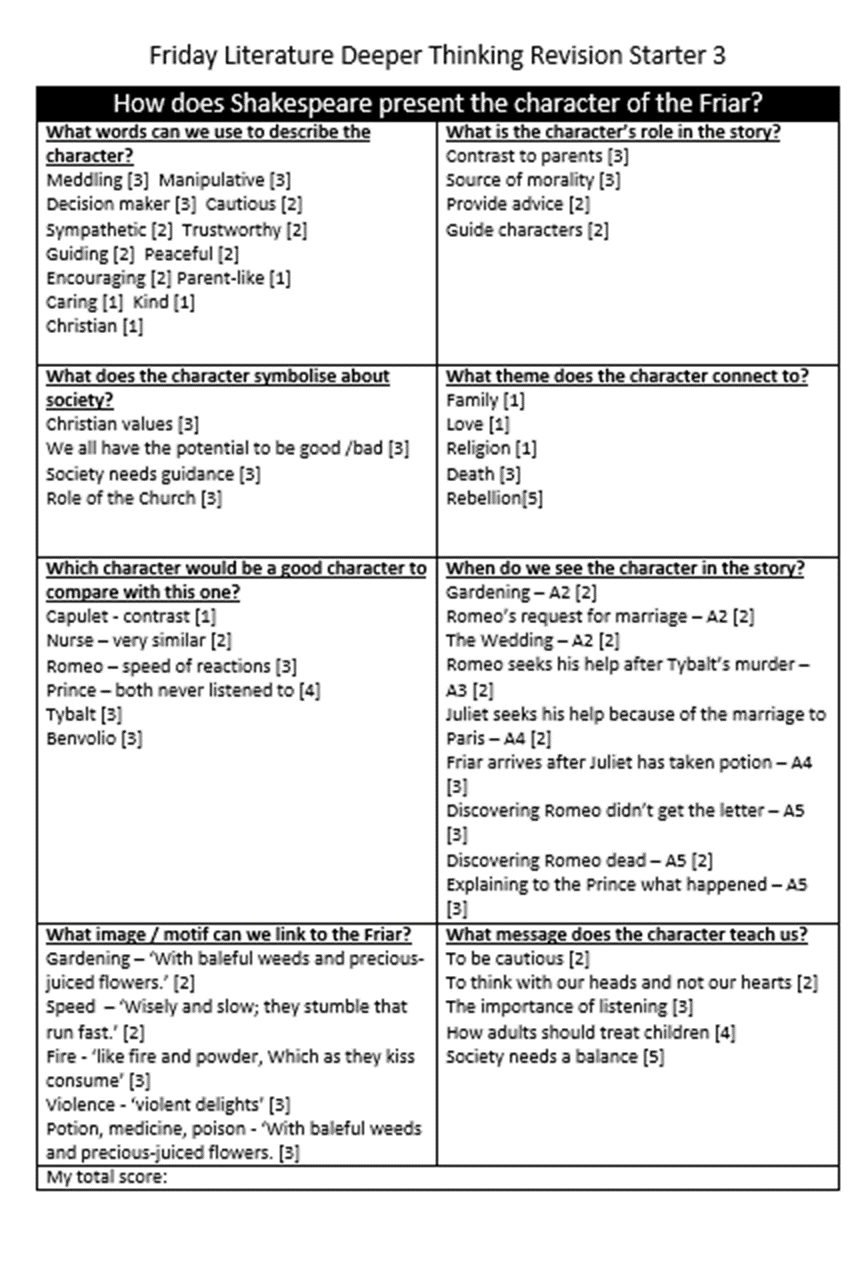
Interestingly, students throw out ideas. I’ve used fatherly, is that ‘parent-like’? If they have an idea that I haven’t included, then I add it and add a score to it. This week I gave one idea 5 marks, because it was so good. The idea that the Friar links to the theme of rebellion. Cue more students trying to outdo that 5 marks. 


What I noticed was a real engagement with ideas and characters. Exploration and ideas were at the heart of the revision. It wasn’t just knowledge recalling, but idea forming… and exploring. It is quite easy to do but the key thing is showing a hierarchy of ideas. That’s where we can help make something abstract seem concrete. The categorising of some words or ideas being better is often something we say but don’t actively work on in lessons. Yes, some words are better to describe a character than others. Some words are precise and some words are general when describing things. 


The texts are massive banks of quotations. Seeing texts as disjointed entities is the problem here. Our obsession on quotations is warping how students interpret texts. They are thinking around the quotations and not thinking around the text. We need to reassert that distinction in lessons. A student that can think around a text writes the best essays.   


Ideas are the interesting things in English and we have a duty to make sure that our subject isn’t all quotations and extracts. If we are not careful, students are interpreting the subject as being all about the quotes and not the ideas. 


Thanks for reading, 


Xris 


Sunday, 11 June 2023

Narrowing down revision in English

Revision and revising is such a tricky thing for English. It can, if we are not too careful, be the equivalent of Buckaroo. Here’s another quotation. Now, add these three quotations. Balance these intent words on your head. BUCKAROO! 


We all love a good quotation, but revision can become for literature all about the quotations and not the ideas. It is really hard to find a balance, because quotations are concrete and they can be recalled so they give the students the semblance of effective revision. The problem is that students can often learn quotations that have no link to the question, yet because they have learnt it they are going to crowbar it into their writing. Is the emphasis on quotation knowledge superseding text knowledge? And, more importantly, text understanding? 


I admit my emphasis on quotations has always been around words or one or two key phrases.  ‘Solitary as an oyster’ works on so many levels that it can fit into most essays. Class - the rich are shut off from their problems. Greed - hiding their riches. Charity - the pearl represents that there is some good in Scrooge. Teach them a good quotation and how it fits in a number of contexts and you are preparing students to think on their feet. All too often, we turn quotation learning into some kind of military drill. Drop and give me two quotations on Tiny Tim. What is that? I can’t hear you. For that, you are giving me four quotations on love in ‘Romeo and Juliet’. The retaining of the quotation is more important the malleable nature of ideas and quotations. They are putty to mould and shape into an argument. 


This year, I played around with revision lessons. Instead of the hunt for a needle in a haystack knowledge retrieval, we tried a very simple structure. I simplified the text in several key images, the characters and the structure.  


I gave students a sheet with these on them. Then, I gave them the question. How does Shakespeare present love? Together, we worked on thinking what were the key images in the text related to the idea of love. We discussed the father’s and friar’s view of treating children like plants. We discussed the idea of cupid and the concept of love being unpredictable. Next, we explored the character across the text. Are there characters that show love? We discussed the combination of Lady Capulet and Nurse and their views of love. We then discussed the different attitudes that Mercutio and Romeo have towards love. The group decided that Shakespeare uses Lady Capulet in an unsympathetic light to show how adults have a conditional attitude towards love. Finally, once we had these ideas we considered the structure. We discussed that we see the parents move from unconditional to conditional love. We also discussed how problematic conditional love is with Romeo and Juliet. The overall opinion was that Shakespeare wanted balance and not one or the other. 


From a simple sheet, we had explored images, character and structure to form and argument in response to the question. Then, we were able to check what existing quotations we could use. In fact, as we discussed these ideas, students freely offered their ideas and quotations. The thinking of ideas started the search for quotations rather than the other way round. 


We then drafted a paragraph for one of the ideas. This took us close to thirty minutes to do, but we have revised images, characters and structure alongside themes and quotations.  In fact, in one lesson we covered three texts like this. 


I know revision season is done for this year (almost) but I think we genuinely need to think about the revision process long-term to avoid the Buckaroo effect. All too often, the closer we get to the exams, the more we attempt to cram and pile knowledge and things onto students. If the teaching of the texts is good, then at the end there shouldn’t be a need to fill students up with quotations. Students should with a few key choice morsels be able to create a dish of an essay. More able students will probably have a few more select and subtle morsels, but the majority will have something. 


Maybe our problem with exams and revision is that the default is that there is an absence of something. We add rather than build on what is there. English is probably the one subject where you are often starting with something. Before students revise the texts, they know something of the story. The power of literature is that it lasts long after the experience. They might not remember the quotations but they can remember the story. There is a spark of something to add kindle to. Hopefully, this is one way to start that fire burning. 


A link to the documents I used is here: https://www.dropbox.com/scl/fi/dp39pt9cgr91f6n2y4r8y/Year-11-Revision-Helpsheet.docx?dl=0&rlkey=r2jpgkdzwidapb5vi0fwrykw1


Thanks for reading, 


Xris 


Sunday, 11 October 2020

Losing my Revision

 You have a test next Friday so your homework for this week is to revise for this test.

You see systems and processes differently to teacher when your children are in a secondary school. You see the impact of the processes.  Revision is one such process I have seen differently. A process that is a largely invisible process in schools. We expect it to happen. We expect students to do it. We expect it to have a benefit. We expect students to have learnt it through primary school. We expect students to have a clear idea of how to do it . We expect all students to do, but it is an invisible thing. Hidden. Locked away. Secretive.

If truth be told, the majority of interventions in school are largely based on the principle that a student will not be independent enough to do the work at home. That’s why we have booster sessions. We have catchup sessions. We have mad panic dashes of knowledge, because the students don’t revise. We, in fact, have a constant cycle of topping up of knowledge when, all to often, the answer is the student’s relationship with revision. I’d be bold to say that when teachers compile lists for interventions it leads heavily on the underperforming and lack of revision. The lovely student with pastel coloured highlighters and a itemised plan of revision doesn’t get a look in. Really, you want to come to the afterschool session? But, you revise?

I also think Knowledge Organisers haven’t helped with revision. They have added to the over simplification of revision. All you need to do is revise what is on the sheet. Just revise the sheet. What we see as obvious and easy isn’t always so. The process is assumed rather than modelled. The assumption is that by giving students a sheet of people they will know what to do with and how to use it.

Our current situation has highlighted how important we get what students do at home right. Revision is even more important now than ever. But, we can’t expect to paper over the cracks with extra interventions. We can’t expect that students will pick up the knowledge through natural osmosis. Osmosis occurs when the student is in the room. That osmosis doesn’t happen when a student isolates for weeks. Thereby, revision is paramount and we have to look at how that revision looks.

This week I have set my Year 10s to revise for an assessment. They have been studying six of the AQA poetry anthology poems. Instead of giving them a simple instruction to revise and leaving all the complexities of revising to inference,  I have created a sheet for them to use for revision. Now, I don’t think it will change the world, but it is a staggered approach to helping Year 10s revise. See a picture of the sheet here:


I have based this on the principle of sifting and refining their notes. They are to give three bullet points for each box. Then, at the end, further summarise with three overall things to remember. The sheet will
show me they have revised for the assessment. I have even said to the students that I will collect the sheet before the assessment. The thinking is that if something goes wrong in the assessment, they have a back-up to prove they had revised. After all, the default reasoning in a poor assessment is that the student did not revise.

We need to make it clearer to students what revision looks like and we need to be explicit that it involves more than reading over their notes again and again. I think as teachers we should model the revision processes for students. Instead of telling students to revise, we model steps and approaches to do. Here, I am trying a ‘summarise in three’ approach. I am sure you could use questioning or dual coding for whatever you are doing.

I feel that we need steps in building revision into our curriculums. We have a note sheet system in KS3. Students can take one sheet into an assessment. That sheet is A4 in Year 7, A5 in Year 8 and A6 in Year 9. We are in the business of teaching our subject but we need to be better at teaching how to revise for our subjects. We might talk about how to revise and give some tips, but do we really check and study their revision? Or, do we just rely on it being invisible and intangible? The problem is: if we treat revision as invisible and intangible, then the students who really need to revise will also see it as invisible and intangible that they don’t have to do it.

Revise. A word that has so much packed in it. A simple command but a whole lot of untapped potential. Let’s change that! Show me your revision. Show. Me. Your. Revision.

Thanks for reading,


Xris


Saturday, 19 March 2016

Anchor sentences


It is that time of year again: exam season. This year I have a group of GCSE students and, so far, they are working between a C and an E. At this stage we have completed coursework folders and completed two full mocks. However, success is slipping away from some of them. Why? For some, it is simply they don’t write enough. For others, it is about a lack of depth in their thinking. Things are, just a little, superficial.
If I am honest, I don’t think teenagers write enough in schools. They don’t write at length in silence. The years of child-centric focused teaching has meant that we struggle to cope with long periods of silence while students are head down writing. In fact, we have turned writing into manageable chunks of work. Manageable for the student and their self-esteem. Manageable for the teacher and their work load. The problem is when faced with the English exam some crumble. I am tempted to photocopy and English exam paper and put it in the pigeon hole of all staff. This is what we need to prepare them for! This is why all students need to write more. For those unfamiliar to the out-going (AQA) exam specification, it contains six questions and for each one students have to write approximately two or more sides of A4 lined paper.  They, in fairness, have to write solidly for two hours. When you have had a curriculum for years of writing for thirty minutes and then moving on to something else, they find this difficult. Our first hurdle is making sure they finish the paper. We will leave this aspect for another blog.

Anyway, the second problem I have is the superficiality of their answers. They are students who are close, but often within a finger’s grasp of the next grade. They keep missing it. On further investigation, I noticed a few things. As students, they can retain a considerable amount of knowledge. Their retention of a range of facts is evident in all pieces of writing. But, then, what is the missing link?
I think wholeheartedly how our students read texts and interact with texts is the problem. They know they stuff; they just don’t read texts effectively. When marking their papers, I noticed time and time again there was a pattern. They were analysing whole texts. All the time they were trying to write about everything. They felt the need to write about the beginning, middle and end all at once. When trying to write about all parts of the text, you default to generalised statements because you can’t cover things precisely. They would be making one point about the opening and the ending at the same time and condensing things together, leaving no room for precise analysis. In a way, this is a reflection of society. The ability to concentrate and focus on one things is hindered by the fear of missing something out. Look at social media. Our fear of missing out is highlighted in some people when they can’t sit still without casually looking at their phone and see if they have had a notification.

What if we built that level of concentration to a focus on one single sentence?
Student struggle to analyse precisely because they focus on everything, so wouldn’t it be better to concentrate their efforts on one sentence?  The sentence would be the starting block. Instead of jumping into whole text analysis, in exams, the starting point is one simple sentence. Of course, they will read the whole text, but their starting point is the perfect sentence. The best sentence. The most effective sentence. Then, the work out from that sentence. Our students struggle because they don’t have a clear anchor to the reading.  

Let’s have a bit of a play with ‘Pride and Prejudice’:   
IT is a truth universally acknowledged, that a single man in possession of a good fortune must be in want of a wife.   

As a sentence it has some interesting points:
·         It is an opinion.
·         It is an opinion that is very confident that it thinks that it is a fact – universally acknowledged.
·         It concerns the desires of men – want of a wife – and not the needs of a man.
·         About the progression in relationships – single man/ wife.
·         The use of ‘IT’ suggests that the writer might see that the opinion as something impersonal.   
·         The use of the present tense highlights how it is a current practice / held thought.
·         The use of ‘must’ suggests that there is no alternative to this thought.
·         The term ‘good fortune’ is vague and unclear so open to interpretation as is what actually refers to. Does it mean money? Or does it mean luck? If so, does that mean unlucky people do not want to marry?


Well, close analysis like this can be fruitful as it anchors thinking on precise detail. Then, the student can then develop that thought by linking to the rest of the text.

IT is a truth universally acknowledged, that a single man in possession of a good fortune must be in want of a wife.   

Links
·         It is an opinion.
We see this when Mrs Bennet reinforces the statement consistently in the novel. She sees every man as a possible husband for her daughters.
·         It is an opinion that is very confident that it thinks that it is a fact – universally acknowledged.
It is a statement held by most characters. Happiness it seems is derived from marriage. The story ends with Elizabeth Bennett marring. In fact, we see several men with money marry by the end of the novel.
·         It concerns the desires of men – want of a wife – and not the needs of a man
At heart of the novel is the desire of one man: Darcy. We also see the desires of Mr Wickham.  
·         About the progression in relationships – single man/ wife
Umm.. we have a few weddings.
·         The use of ‘IT’ suggests that the writer might see that the opinion as something impersonal   
Look at the transactional relationship between Mr Collins and Charlotte Lucas – marriage can be something transactional
·         The use of the present tense highlights how it is a current practice / held thought
The novel can be seen as evidence for the prosecution.
·         The use of ‘must’ suggests that there is no alternative to this thought
Look at the fear characters have about not being married.
·         The term ‘good fortune’ is vague and unclear so open to interpretation as is what actually refers to. Does it mean money? Or does it mean luck? If so, does that mean unlucky people do not want to marry?
Mr Darcy’s happiness is dependent on one particular marriage.

That was me being silly and using my hazy knowledge of ‘Pride and Prejudice’. But, the one quote, a perfect quote, can work on so many levels. Why are we crowding these students’ brains with so many quotes when three or fewer could be meaningful? Could there be one sentence in each of the main poems a student could learn to the depth of the Mariana Trench. That becomes their anchor to the whole poem. They sit the exam confident with one line. They talk about the whole text but group it with one line.  
Honor the charge they made,
Honor the Light Brigade,
http://poetry.eserver.org/space.gifNoble six hundred.

Points

·         Repetition of honour shows that we must honour these people more than others. And, we mustn’t forget to honour them.

·         It is an imperative – the writer is angry and demanding we do something – there isn’t a choice for us.

·         The use of ‘six hundred’ is a factual statement and precise about the soldiers. It is specific about the amount who died to make this personal and highlight the point they died when then odds were against them.  

·         The adjective ‘noble’ is the only adjectives to describe the hundred. They don’t need endless words to describe them. One word sums them up. The use of ‘noble’ suggests that they are some form of royalty or having excellent qualities.

·         The use of ‘charge’ instead of ‘fight’ puts the emphasis on the action before rather than the physical battle. The poem doesn’t dwell on the physical aspect of the deaths. He focuses on the causes and the consequences. He is respectful enough to not show us the gory details.


I could go on and on with looking at my anchor sentence. The next step would be to link the sentence to the rest of the text. When we teach students texts, we might zoom in on words or techniques, but most of the time we are doing this whole text reading. For your sophisticated reader, that will be fine. But, for students, who struggle with reading, it is hard to shift between whole texts and parts of the text. Maybe we have to help the less able readers to do this anchoring to a text. Most of us will probably teach by taking extracts from a text and getting students to analyse them. But, what if students had one line about Lennie that they knew in such depth? Surely, when faced with a question they have never seen before, they will be able to look at their quote and adapt it to their answer. Look at the example for ‘Charge of The Light Brigade’. You could use that for most questions in the poetry exam.

For the next mock, I am going to set students to select an anchor sentence in a non-fiction text. For revision for the literature exams, I am going to work with the class and get them to create their own poetry anchor sentences. If we want precise analysis, we need precise thought and decluttered brains. If students revise poetry by learning a shed load of features in the poem, they will just try to repeat all those features. If we give them one sentence they know well, they will have a clear starting.

I’m sailing off now.

Thanks for reading,

Xris  

Sunday, 17 May 2015

Revising, revision and the long game


It is a universal truth that a student wanting to succeed in exams will often lean towards one subject rather than another, because it is easier to revise. The Science exam will take precedent over the English exam, because it is easier to retain the information due to its factual, concrete nature.
 

For me, the English exams start tomorrow. English Literature. The first of many for my students. As with most things, I get a bit reflective. Did we do enough? Did I do enough? Did the students revise enough? Are they revising while I type this?  Crucially, have we trained students to revise in English?

The recent discussions on skills and knowledge have changed the way I think about curriculum planning, but, like most people, I am starting to think of the new GCSEs and how they will pan out. I am not daunted by the fact that students will have to deal with a closed book exam. Nor am I bothered about the choice of texts. Nor am I bothered about the questions. I am, in all honesty, not that bothered about much. It is business as usual as far as I see it. No, the thing I am thinking about is how we can prepare students over time. The long game.  

Do we prepare students for the long game? Because we see English as predominately a skills based subject, we often focus on the present and the short game. If they can do it now, they will be able to do it in the future. Our curriculums seem to be focused on a jigsaw approach to learning. Students build the jigsaw. Then, they move on to the next jigsaw. Next year we will ask them to make the same jigsaw again, and hope they have remembered how to assemble the pieces to make the picture again. Finally, in Year 11 we insist that they revise how they made the jigsaw.

I think other subjects benefit from their knowledge content. They can have an end of topic test. They can have an end of term test. They can have an end of year test. They can even build in tests at the end of a lesson or a key stage. In the DNA of their subject is revising. Listening to students talk about other subjects is interesting. I have a French test tomorrow. Have you revised for the Geography test? When have I heard a student mention the word test in association with English?  Maybe, I have heard the phrase spelling test, but not anything else. A test in English is usually an assessment.   But, for me, and I think for others, an assessment is something much bigger than a test. A test is a quick indicator of knowledge retention. And, an assessment is an indicator of a student’s ability to use a collection of skills.   

I think in English we are too subtle with things. We hope that the essay the students are writing will imply that the student knows what a concrete noun is or the difference between personification and a simile. We hope the knowledge will be bubbling under the surface for all English teachers to see. We will tick off the skills as they use them in their writing and make inferences about the knowledge the student has gained. Yes, they have used the name of the characters. That shows they know something about the story. But, does it truly reflect the sum of the student’s knowledge?

Let’s take the humble noun and all its different forms, such as proper, common, collective and abstract. When do we test students about the differences? Do we test them on it? The majority of students will know the difference between them at the end of Year 6. What do we do with that knowledge? Do we check to see if it is there a year later, a key stage later or even at the end of Year 11?

I’d say most of us would refer to the different types of nouns several times in the course of teaching. What do we call these kinds of noun? We revise the term, but we don’t make the students revise it. We revise, but they don’t. And, I think that is what I am trying to get at. Collective revision is nice in principle, but it isn’t getting students to revise. We are not preparing them for a future where we want them to revise if there is a single point where we say, ‘Learn this on your own.’ We are never building them for retention of knowledge if we don’t build it in to what we do day-by-day.

How many English departments have an end of year test? Some. A few. How many of those end of year tests are assessing skills developed across the year? How many of those tests actually test what knowledge the students had learnt over the year?   

What is a sonnet?

What is the purpose of a sonnet?

What is the volta in a sonnet?

Before people start throwing exam papers and staplers at me for undermining the complex nature of learning and spoiling the fun of learning, listen to this:

What if, in addition to our usual assessments, we had only one end of year test (yes, only one) at the end of each year? That test would be mixture of the basics (grammar terminology) and topic specific knowledge. The students would have a list of terms and aspects to revise a week before the test. Then test.

We have repeated the learning process. We have consolidated the learning.  We put at the front core knowledge. We have modelled revision.

Let’s stop assuming that just because a student learnt what a noun is in primary school it stays in their brain forever.  Let’s stop assuming that mentioning what a noun is occasionally will not keep that definition for a noun lodged in their heads. Let’s assume that we have to do something annually that anchors that knowledge. Let’s assert the role students play in the learning. They have to actively revise in English. We have to teach them to revise. Otherwise we get to Year 11 and students look at us bemused and confused about how to revise for the exam next week.

Thanks for reading,

Xris