Showing posts with label structure. Show all posts

Sunday, 10 March 2024

Symbolism, structure and chat

It is that annual time of year where I teach Question 3, the structure question, to students. The more I teach this question, the more I think we need to work more on symbolism in English. And, to an extent teach them the background knowledge to identify those symbols. Symbolism is what we think we do a lot in lessons. We look at poems and explore the symbols through similes, metaphors and personification in them. Yet, when we take out metaphorical language, students find it really hard to spot and discuss them. 


Every play studied has lots of symbolism embedded in it yet symbolism tends to be isolated to the language. A character giving a soliloquy on stage on their own is a symbol of isolation. A scene set inside can be a symbol of secrecy and a lack of transparency. A scene set at night symbolises something bad, sinister or that something is ending. An Inspector Calls being set at night is symbolic. It is all leading to a new ‘dawn’. There’s a reason it is set at night. The end of the old ideology.   


The problem we have is that students can’t get their head around the idea that symbolism is often not linguistic or figurative. It is structural. I think over the years we have become too focused on identifying techniques to the point that we have missed something powerful within our subject. The meaning around all choices a writer makes.  Over time, we have subconsciously created a hierarchy around choices that sensible choices around structure, positioning or content are neglected for something with a name. Something easily nameable. Something easily tested. Something easily taught. In fairness, something that is easily explained, but not something that is easily explored. 


Symbolism is fuzzy. In one context, an object can symbolise and then in another it can symbolise something completely different. Take the colour red. It can symbolise paradoxically positive and negative things. It can represent love and passion, but also it can symbolise death and danger. Our job is to help students see that duality and how it fits in the context of things at the moment. 


The reason Question 3 is such a difficult question is that you cannot explain it fully, because it is a question about exploring. It is why we see so many people tripping up on it. Let’s teach them about cyclic structures because we can explain that. That generates lots of students explaining a cyclic but not of them explore it.  


Let’s have a look at things in one of the past papers. The following images are from the ‘Labyrinth’ paper. 

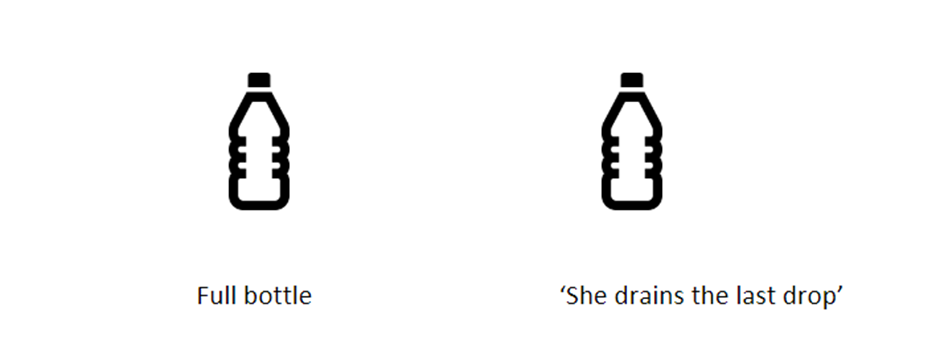
The bottle of water is often skipped when students read this paper. However, structurally the bottle symbolises so much about the character. Water is a symbol of life. Here we see that character’s full potential and her hope at the beginning. At the end of the extract, we see how that hope and potential is running and at risk. One last drop represents her one last hope that she has in the situation. Yes, there is a cyclic structure, but in terms of storytelling there is so much going on here. The bottle is a symbol of her hope. The story is structured around her lack of hope or the slow dwindling hope she had. 


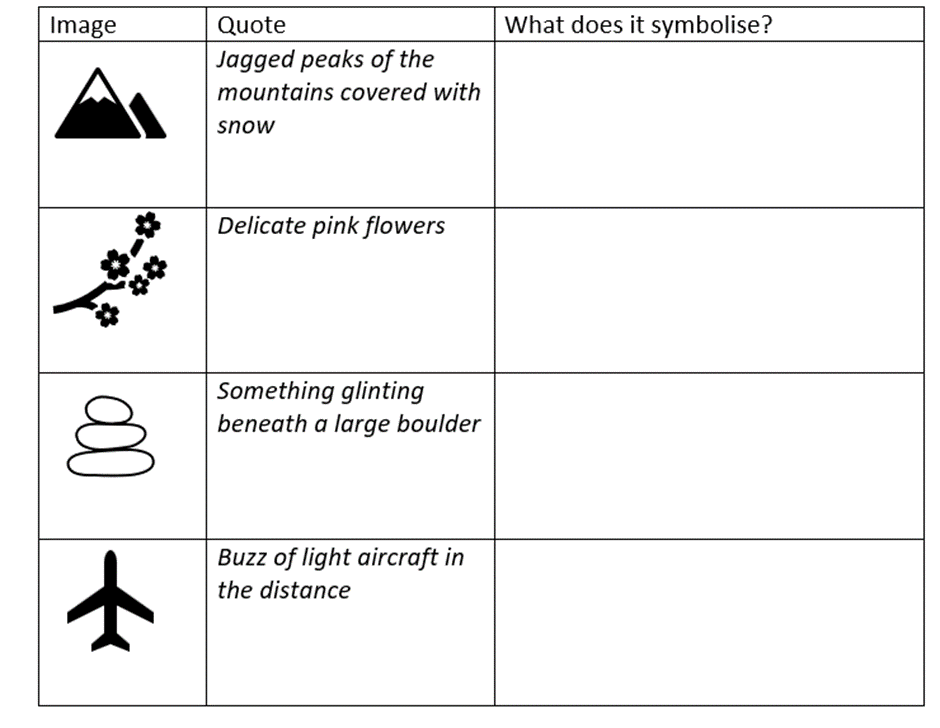
We can take that further in looking at other things described. 


Each one connects to the character’s personal journey. Usually students focus on the reader and how the reader feels, when actually they’ve missed the character and forgotten about the reader’s interaction with the character. The images above are all about lots of big things. They symbolise how things are against Alice. She is looking for something small and the odds are stacked against her. The plane is a symbol of her imminent journey home. The mountain is a symbol of the challenge before her. The flowers are a symbol of her but also her hope: small, delicate and time-sensitive. The boulders are a symbol of another obstacle, like the mountain, that is in her way. 


Then, we can see how the whole thing is put together. She starts with optimism, but that is slowly dwindling as the story progresses. 


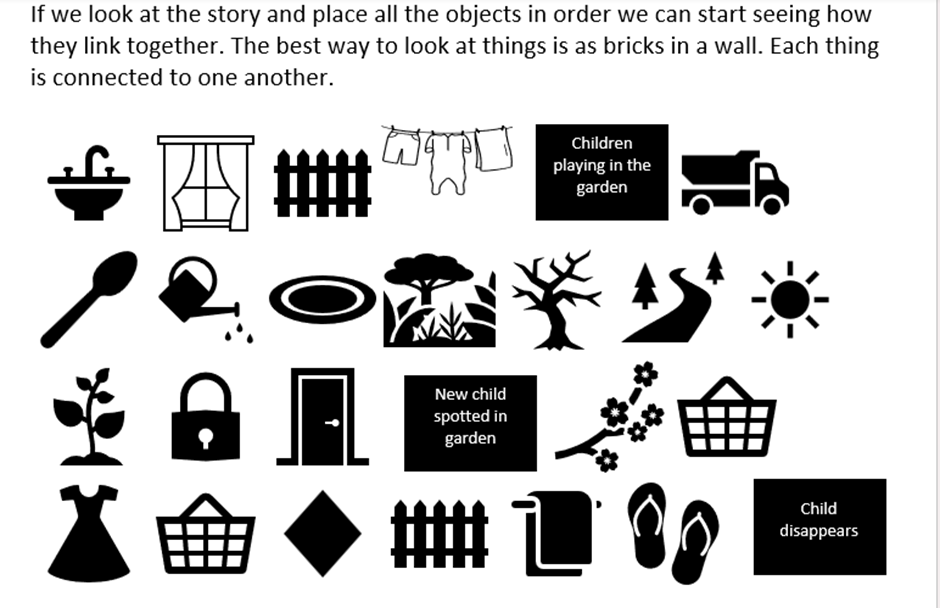
That exploration is really important, but we aren’t allowing students to do it enough. Here is another example I used with students. This goes alongside the ‘Silk Factory’ paper. Here what is interesting is the use of domestic imagery and symbolism. It is used in the story to convey a sense of safety. We have repeated references to domesticity which provides us with comfort and a level of expectation. That is contrasted with the dangerous elements in the garden. 


I think we need to get exploration back into the classroom. We’ve become too obsessed with explaining that we’ve got ourselves in knots over it. Look at how our analysis has become knotted with paragraph structures. PEEL. PEE. PEETAL. What/How/ Why. Our discussion in the lessons has placed emphasis on the concrete. What technique does the writer use? Why has the writer used it? We’ve moved away from abstract thinking and that’s where symbolism comes in. You can teach explanations, but the student independently explores in English - with a little direction from the teacher. 


Building confidence in exploration starts with talking. Getting students to talk about images amongst themselves and exploring what they could mean is paramount. That talk gives them experience and confidence. The melting pot of ideas. Here’s a little discussion sheet I have created for Year 10 as we explore this question.


It isn’t a writing frame, but a discussion tool for them to articulate what they notice about images, symbolism and storytelling. It isn’t  perfect. It isn’t definitive. But, it is something to latch ideas onto. Let’s take a break from explaining and let’s open our lessons to exploring. 


Thanks for reading, 


Xris 


Sunday, 21 June 2020

I love the smell of red herrings in creative writing

I make no bones about it but I cannot stand ‘Freytag’s Pyramid’ for story writing. In fact, I loathe its very existence. It warps stories beyond all recognition. Makes storytelling a simple box ticking exercise and it is one that would put me off writing a story. For life.

Recently, I have been marking a set of Year 10 Question 5 responses. In the same week, I was looking at rewriting parts of our horror / gothic horror unit in Year 8. And, a simple case of happenstance made me join some cognitive dots. The Year 10s Question 5 responses were reasonable but they were not wowing me. Students had a picture of a beach and they were describing the sea and an island in the distance. There were some lovely bits of description and ideas, but they were flat and monotonous. They were full of bits of description and nice bits of description at that, but they were largely one tone. Flat. Now, it is easy to blame structure and a lack of ‘Freytag’s Pyramid’ but something was missing. And, for me, that was a puppeteer. Story writing is akin to being a puppeteer. You have a number of strings to pull with an impact on the overall story. Students need to have an idea of the strings and when and how to pull them. A large number of strings are not used, but one or two are. But it is the knowing when and how to pull a string that is key.

Anyway, I was planning some work for Year 8s. We spend a term looking at gothic fiction and within that I have wanted to explore how horror directors employ a number devices when filming. Here’s some of the things we are looking at.

Techniques employed by film directors and writers in horror films   

A false sense of security – the writer makes everything seem safe when in reality it is not
Anticipating the worst – the reader is expecting something terrible and they don’t know when it will happen
Dramatic irony – when the audience knows something the characters don’t
Empty space – the writer makes the setting empty so that we think nothing can affect our main character 
Jump scares – this is when –  BANG -you get a shock suddenly without any build up
Mise-en-scène – everything that is in the scene / setting –how things are placed
Nonlinear sounds – these are sound effects that don’t fit in with the story – they seem odd
Red herring – a false clue designed to put us on the wrong path of what is really happening
Slow reveal – this is when the writer reveals a key piece of information slowly and one bit at a time
Stock character – an easily recognised, and predictable, character for the genre – we can easily tell who they are from their clothes and behaviour
Subverting expectations – when the writer breaks the rules of what we expect to happen in the story
Suspense – a feeling of being anxious or excited, but unsure of the reasons why
Twist – this is a reveal and it changes everything we know about a character or story
Underexposure – where the writer using lighting / darkness to hide things
Unreliable narrator – the reader thinks they can trust the narrator but they cannot and they mislead them

We need students to be puppeteers in the writing process. Directors are puppeteers. They control the story. They help direct the story and how the story is told. That’s why I think it is important for us to develop story telling rather than, solely, story writing.  ‘Freytag’s Pyramid’ is about story writing but not about telling. Directors are focused on story telling.
Take our descriptive writing for Question 5. Here’s the picture we used:


How could you structure a piece of writing around subverting expectations?

Example 1:

Paragraph 1 – A beach is calm and quiet.
Paragraph 2 – A person steps their toe in the water.
Paragraph 3 – The reality is that they are stepping a toe in their bath at home. In a dull, tiny flat.

Example 2:  

Paragraph 1 – A beach is calm and quiet.
Paragraph 2 – A person is calm and quiet.
Paragraph 3 – Beneath the water several sharks are hunting and waiting for life.

Example 3:

Paragraph 1 – A beach is calm and quiet.
Paragraph 2 – A person steps their toe in the water.
Paragraph 3 – A person removes their headset to reveal that they are in the future – a world without light and nature.

Each of these structures would include complication, crisis and exposition but the story telling is key. How you structure the story hangs not on endless crises but around a structural device and how you use the device. That’s why I think, we as teachers, need to be thinking about how writers use a technique. Thought about how to use a device / techniques is imperative with helping students to use something effectively. The danger is that we give these devices to students and then expect them to use them without insight, understanding, knowledge, experience.

Let’s take another one of the devices employed by directors. How could you structure a piece of writing around a red herring?

Example 1:

Paragraph 1 – A beach is calm. Slowly a fin pops up.
Paragraph 2 – Something is moving in the sea while a person moves towards the sea.
Paragraph 3 – The person enters the water and the thing heads to them and dives between their legs. A herring. A waves sweeps the person out to sea.


Example 2:


Paragraph 1 – A quiet beach.  A person takes off their clothes and pile them up. They place a letter next to the pile and rest a stone on top of it.
Paragraph 2 – The person goes out into the sea and swim out to the deep.
Paragraph 3 – The person and returns. The letter has blown away.

I feel that we need to get better at talking about the structuring and creation of stories. We, often, through a lack of experience and knowledge paint story writing with big large brushstrokes. We need a more succinct and precise approach to discussing story telling. ‘Freytag’s Pyramid’ represents this exact problem. That are four billion ways to create a complication. That richness is neglected when reduced to a pretty picture.

There is an art to puppeteering. We want students to be sophisticated puppeteers when they write, but we teach them as if they have a sock puppet. They needs strings and lots of them. But, they need guidance on what the different strings do and how to manipulate the string to create a variety of effects.

We need to teach students how to use each string. In fact, we, ourselves, need to be clear about how to use each string. It is not enough to spot a string. You have to know about the length, the connection, the amount of pressure, the position of a string. 

Thanks for reading,

Xris

Sunday, 12 March 2017

AQA Exam Update: Questions 3 and 4 bore galore


We are on that last big push for the final exams. We have taught the set texts and we are practising and practising for the exams. At the moment, my Year 11 class is working through Paper 1 with the opening of ‘Rebecca’. From the marking of their mocks, I have come up with these few points.


Point 1: Question 3 (Structure)

With the structure question, I have found that students produce more meaningful comments when the emphasis is based on the effect. Starting with a device leads students to obsess on the structural device and fail to explain things fully. When students focus on the effect first, they look for the structural device to support their idea.

This is the slide I gave students. They had to find these ‘effects’ in the text. Then, they had to explain the structural device to support it.

The writer is trying to make the reader curious about what is happening.

The writer is trying to make the reader sympathise with the narrator.

The writer is trying to make us feel like we are there.

In discussions, this led us to explore the use of narrator, the shift in focus and use of description. If students are to attain the high marks, we need them to independently engage with the effect and develop sophisticated explanations of the effect. Plus, they need a bank of readymade effect comments. They, probably, need to be a regular part of the language of lessons. I don’t suggest for a minute that we give students a list of comments like the above, but I suggest that we use these phrases more often in lesson.


Point 2: Paper 1 Extracts

Now, this is an idea adapted from something I saw on Twitter many moons ago. It was a simple idea to get the whole school shadowing the Carnegie Book Award. The idea was simple. You photocopy the opening page of the books and passed them out during tutor time. Students then judge which book is the based on the opening.

The shortlist is released this week and I am going to order all eight books. Then, for the next eight weeks, we are going to explore the opening of each book in English lessons. Now, here’s the interesting thing: I am planning on doing this with Years 7,8,9,10 and 11. Teachers are going to use the texts with their classes. Year 10 and 11 might have them as complete booklet, but KS3 will have the revealed a week at time.

We are going to have a clear focus:  narrative perspective and structure. How is this story told to us? What is interesting about how it is structured? I might even throwing in an opinion to support: Frank, my mate down the pub, thinks this opening is the biggest pile of tosh written in the last ten years. How far do you agree with Frank?

I am not a big fan of giving KS3 students GCSE papers and I am not too impressed with the KS3 test papers as I feel they are just repeating the questions rather than developing skills and knowledge over time. However, this approach will give staff a break from planning lessons, but it will develop this structure aspect as a school and a department. We are all looking at the same text and collectively discussing things. At the end we can vote for our favourite.   

I will use Twitter (@Xris32) to discuss and explore the texts over the next few weeks.


Point 3: Question 4 (Evaluating)

Again and again, we hit a block with Question 4. In fact, on any test, I twitch and start panicking whenever I see a question 4. However, I am very grateful to somebody on Twitter for providing this question and exam paper.

04:          In this question, focus on the whole source.


A student, having read this text, said: “This part of the text introduces a place, but it also introduces a character. The writer creates tension by giving us clues about the narrator’s life at Manderley.”

       To what extent do you agree? [20 marks]

       In your response you could:

       consider your own impression of the narrator and of Manderley

       evaluate how the writer presents the narrator and presents Manderley

       support your opinions with quotations from the text


Right, this week I tried something different and I was surprised how successful it was. I fail often with lesson ideas, but those failed ideas I hide from the public. I taught student to break down the opinion statement into three parts:

“This part of the text introduces a place,


but it also introduces a character.


The writer creates tension by giving us clues about the narrator’s life at Manderley.”

These are the starting points for their ideas. Then, I introduced the following words: Typical / Unusual / Predictable / Effective.

They then had to say which word they would use to describe the aspect in the text.

·         “This part of the text introduces a place, [typical]

·         but it also introduces a character. [unusual]

·         The writer creates tension by giving us clues about the narrator’s life at Manderley.”[effective]

Now, in future, I might change the words, but the students started engaging and evaluating the text quickly. Students started saying how typical is was for writers to start with a setting. They said it was unusual to not describe the character when introducing a protagonist. They felt the writer effectively created tension.

The next stage was to explore the methods:  

·         “This part of the text introduces a place, [typical]

o   Journey / personification / slow reveal / constant barriers / contrast

·         but it also introduces a character. [unusual]

o   personality implied / structure of sentences / limited use of first person / few opinions

·         The writer creates tension by giving us clues about the narrator’s life at Manderley.”[effective]

o   Repetition of barriers / use of mystery / questioning


The final stage was to look at the effect of these and link it all together. What is the effect of using a typical introduction of a place?

The benefit of structuring the analysis in this way, like the structure question, is that you are address the important stuff first. If students can start making pertinent comments and statements from the start, the explanation will improve. All too often, the most important comment is made at the end of a student’s paragraph and we have to wade through drivel to get to it. This pushes those points at the front.

Step 1: Typical / Unusual / Predictable / Effective.

Step 2: Methods

Step 3: Effect.

I found it helpful to use the same text twice, but give them a different opinion statement. 

“The opening is incredibly creepy[Point 1] and mysterious [Point 2]. It is effective in the way it builds and creates mystery [Point 3]. ”

Time will tell if it is useful for all students and groups. At the moment, it seems to be working with my class.


Thanks for reading,

Xris

Sunday, 17 April 2016

The One about Structure - Part 2 SPOILERS!


Warning: This blog contains spoilers for ‘The Walking Dead’.

Writers lie, steal, trick and surprise you. If there is one thing, my many years of reading has taught me is this little sentence. Over the last decade I feel that the way television programmes have been structured to reflect the novel’s approach to narrative. And, at the heart of a novel’s journey is the little, evil writing deciding when to lie or trick or surprise the reader with his or her tiny little puppeteer hands. They pull the strings.

Look at the programmes popular today, ‘The Walking Dead’, ‘Game of Thrones’, ‘Broadchurch’ and ‘Happy Valley’. Yes, they have some interesting things about them, but what is more interesting is the structure of such shows. They playfully exploit the structure of their narratives. Several years ago I switched off television because the shows became so formulaic. A glut of American shows followed such a rigid formula. Take ‘C.S.I.’. It had a structure. A crime has been committed. The crime is investigated. The crime is resolved. Times that by twenty and you have one season of the show. Move the setting to a sunny place and you can make more of the show and just give it another name. The problem, if we are honest, is that the crime drama is easy, safe and ‘comfortable’ as a formula. Things can be wrapped up and solved quickly and you only need to retain the main investigator’s name for the next show. There is no intellectual baggage. The actors draw people in and the routine and familiarity keeps people coming back for more.

Shows after a while realised that audiences sometimes dropped off. So, ‘plot-arcs’ were introduced. A mystery was threaded across the series and you had to watch to resolve the mystery. Then, in the finale, the mystery would be resolved and then a writer would hint another mystery. For me, television shows are waking up to formula apathy. I stopped watching medical dramas when I met the third young rookie doctor who knew best and my fourth kind-hearted nurse with a problem at home. Look at some of the dramas mentioned above:

The Walking Dead / Game of Thrones – The story doesn’t follow our moral expectations. Characters good, and bad, die in the most horrible way. There’s no Eastender’s moral justice.  Any character can be suddenly taken away, eaten alive or die a long, drawn out, Dickensian death. You know the characters have all got a chance of being food for the zombie-eyed worms. You just don’t know when or how.    

 Broadchurch / Happy Valley – The story is the subplot and the character’s feelings is the main plot. We watch how these people deal and react to events. We know, in part, what is going to happen. We place ourselves into the drama. 

So why am I talking about television when I looking at Q3 of the new GCSE English Language GCSE?  Well, for one, I think our students are far savvier about structure than we like to think. We just don’t make it explicit it enough. They are consumers of stories daily, yet that consumption isn’t analysed and discussed, and I think it needs to be. I also think structure is neglected in the classroom, because we have so few resources. But, and that’s a large but, students know vast amounts about structure already – they have absorbed it. Take the following plot point:

A character in a story is the happiest they have ever been and they have just married the man of their dreams. 

Ask a student what happens next and you’ll see. They know and, importantly, they know why this happens in drama. Now you could spend a few lessons teaching students about Fortuna or Dame Fortune, or you could look at the text closer. I have changed my view of text structure considerably over the last few terms, and I haven’t gone on to make students learn obscure terminology, because, I don’t think it is needed – look at the AQA examples.


I have found that short films are particularly helpful when getting students in the structure mood. I particularly like a short film called ‘A man afraid of falling’. I spent quite a bit of time getting students to summarise what the focus is on. Sometimes, I used single paragraphs to do this. The following is from H.G. Wells’ ‘The War of the World’. 


  1. The end of the cylinder was being screwed out from within.
  2. Nearly two feet of shining screw projected.
  3. Somebody blundered against me, and I narrowly missed being pitched onto the top of the screw.
  4. I turned, and as I did so the screw must have come out, for the lid of the cylinder fell upon the gravel with a ringing concussion.
  5. I stuck my elbow into the person behind me, and turned my head towards the Thing again.
  6. For a moment that circular cavity seemed perfectly black.
  7. I had the sunset in my eyes.


Turn them into one or two word summaries:

1.       Cylinder

2.       Screw

3.       Knocked

4.       Screw drops

5.       Elbowed

6.       Hole

7.       Blinded 


The great thing of doing it like this is it simplified things, but it helped to engage with the content of the text. Students noticed it:

·         Keeps referring to the screw

·         Zooming in – getting closer to the creature

·         Repeats physical action

·         Keeps referring to the vision getting blocked


Once we had explored this, we able to explore the effect of these particular choices of focus.

Why does the writer keep referring to the screw?

Why does the writer describe the cylinder first and then zoom in on the hole?

Why does the writer repeat the physical action?

Why does the writer keep making the narrator’s vision blocked?


Now, there is a problem with this aspect, because there are simply two parts to the effect thing. One part is the meaning. The other is the drama. Often these, I think, are fudged together as the effect and marked as one and the same thing. 


Why does the writer keep referring to the screw?

M: Shows the narrator’s obsession and concentration on what inside the cylinder

D: Heightens the tension as the screw is moving by an unseen figure. The use of the screw reflects that there is something inside, but the focus on a screw hides any clues about the figure identity.  

Why does the writer describe the cylinder first and then zoom in on the hole?

M: Shows the movement of narrator – they are gazing in to the machine

D:  Creates a sense of size and gravity of the situation. All the characters are looking at the cylinder, yet all they are focused on is a simple screw.

Why does the writer repeat the physical action?

M: Shows the how the other people watching the events are keen to see what is inside.

D: Takes the reader’s focus away from the main event. We want to see what is inside, but other events are taking place that distract the narrator and the reader.

Why does the writer keep making the narrator’s vision blocked?

M: Shows the narrator’s impatience at what is happening.

D: Makes the reader experience things like the narrator and builds up the tension. We are awaiting the reveal, but the writer keeps pulling back from the reveal. When we expect to see something, something gets in the way.

This might look like this:

       The opening two sentences focus on the cylinder, because all the people’s attention, including our narrator’s, is focused on the cylinder. The repetition of ‘screw’ four times in the opening paragraph gives a sense of the obsession these people have, which might be as a result of their fear for their lives, or just curiosity. The two sentences closely followed one after the other shows how there is nothing else they are bothered about.


       The writer toys with the reader’s and the narrator’s emotions. Both want to find out what is inside. Yet, the writer misdirects the reader. After obsessing about the screw, the narrator is ‘blundered against’ and turns away breaking his attention away from the discovery. Then, to make things worse, after the screw has been removed, the narrator can’t quite see because the sun is in his eyes. Vision is important here as the reader wants to see the creature but the writer is constantly blocking his sight to hinder his view of thing. This creates an overwhelming sense of frustration and holding back of key information.   


       The length of the sentences reflects the sense of pace of things. The sentences get progressively longer as the anticipation builds. This reflects the narrator as he is metaphorically holding his breath, waiting for something to happen. Again the writer, fools us with one sentence at the end, which most writers would use to create drama and describe a dramatic event like a hand poking out. Instead the writer describes: ‘I had the sunset in my eyes’. This is an anti-climax as all the previous sentences have built up to a reveal and the writer fails to deliver that and subsequent tension is deflated.


When planning for teaching this aspect, I went through lots of stuff and some of it was provided by AQA. What has alarmed me is the incessant focus on narrative perspective. It, I think, is dangerous when talking about structure. It takes a sophisticated reader to comment effectively on narrative perspective directly. It is told from a first-person perspective to make us experience things ourselves and it…. Umm… errr. Did I say the extract uses a first-person perspective? Recently, I sat through some training on the exam paper and the person leading the session informed us that ‘a sentence’ is appropriate technical terminology for describing structure. Therefore, students talking about the first and last sentence would qualify for using technical terminology.   There has been, however, a lot of frustration over the terminology aspect. We have finally had a list, but I don’t find it especially helpful for teaching structure.

I feel that maybe students understanding before they look at techniques that writers shape a story and that they lie, steal, trick and surprise you. The recent finale to ‘The Walking Dead’ was brilliant, in my opinion. However, some were disappointed. Fans of the show knew that a new villain was due to appear in the story and this has been hinted at throughout the series. In the comics on which the shows is based on, the villain brutally murders a beloved character in sight of all the other characters. But the writers included the infamous scene, but they will devilishly cruel with how they presented it. We had the villain swinging a bat at each character. Then, we had the villain tell the characters that he is going to kill one of them. Then, he decides which one to kill by singing ‘eenie meenie miney mo’. The camera at this point switches through all the characters. We then get a shot of the villain taking aim to kill one of the people. Finally, we switch to the perspective of the person being killed, including blood pouring down the screen. Yes, someone was killed, but we didn’t find the identity. For me, I thought it was brilliant. We had been promised a death, but we were tricked. Some like me loved it; others hated it. But, it goes to show what writers do when they shape the narrative. That’s why I think we need to be looking at some of the following technical terms or ideas when exploring an extract:

Ambiguity

Anti-climax

Changes

Climax

Contrast

Cumulative

Digression 

Foreshadow

Juxtaposition

Misdirection

Perspective

Red-herring

Reveal

Reversal

Secrets

Tricks


‘The Walking Dead’ built up the audience’s expectations through constant foreshadowing of the villains arrival. When we think the villain is going to kill someone the focus is vague and ambiguous to confuse the audience. They misdirect the focus on who is going to be killed. Then the perspective is changed, so just when we think we know who is going to die. It is again hidden from us. Therefore, the whole ending was a red-herring. We were promised a character was going to die in the episode. They did die, but we just couldn’t tell who it was.

 We must make students see that writers lie, steal, trick and surprise us. Importantly, we need to show students examples of writers doing this. ‘The War of the Worlds’ does just that. The rest of the extract I use ends with the narrator running away. After spending the whole extract getting closer and closer to the cylinder, the writer then ends the extract with him running away. Also, the writer tricks us by making two creatures appear instead of one. In fact, curse that H. G. Wells, that’s all he does is one trick after another. 

In my attempts to help students discuss structure effectively, I have used poetry. This poem by Imtiaz Dharker made a great starter for exploring structure.


The skin cracks like a pod.

There never is enough water.


Imagine the drip of it,

the small splash, echo

in a tin mug,

the voice of a kindly god.


Sometimes, the sudden rush

of fortune. The municipal pipe bursts,

silver crashes to the ground

and the flow has found

a roar of tongues.


From the huts,

a congregation: every man woman

child for streets around

butts in, with pots,

brass, copper, aluminium,

plastic buckets,

frantic hands,


and naked children

screaming in the liquid sun,

their highlights polished to perfection,

flashing light,

as the blessing sings

 over their small bones.


I used the poem with a Year 8 class, but I moved away from your typical structure questions, instead I went for these questions instead.


First:

       How do they introduce the setting?

       How do they introduce the characters?

       How do they introduce the history / background to the events?

       How do they introduce drama?


Then:

       Where does the writer trick us?

       What does the writer change perspective?

       How does the writer prepare us for the end of the poem?


As a class, we discussed the poem’s structure at length for a whole lesson. Below are some of their points:

·         Starts and ends with skin

·         Given how much important water is, it is never really described in the poem

·         Keeps referring to parts of the body

·         People introduced through their pain

·         Follows a structure of skin, sound, skin, sound or sound, physical action, sound, physical action

·         Moves from pain, sadness, lack of life  to freedom, joy and life

·         The water is the key point of drama and separates two parts of the poem


When describing the poem, we could now introduce terms, although not overly complex, like reversal and juxtaposition. The drip in the second stanza could foreshadow the rush of water later on. In a way, I think we have to be more attuned to structure. Before, I always focused on the opening, ending and the order of things. I think we have to be more precise with how and when things takes place. We need to get our hands dirty and look at things precisely. Poetry I think is great for preparing students for looking at structure. One stanza can be packed with loads of structural choices. I also found the following helpful for students:


What is happening across the text?

moving towards vs moving away

inside vs outside

constant vs varied

decreasing vs increasing 

moving vs not moving

speech vs silence  

action vs description

1st person vs 3rd person

emotions vs emotionless


To reflect back on the opening sentence, ‘this blog contains spoilers’. This foreshadows a secret later. I then digress and avoid talking about the main purpose of the blog by talking about television.


I am sure I will have some more thoughts on the question later in the year. A big thank you to Mark Roberts and @MrRDenham for their recent offerings on this particular question.

Thanks from reading,

Xris