Showing posts with label An Inspector Calls. Show all posts

Sunday, 18 January 2026

Metaphor, Oracy and Real Speech in An Inspector Calls

One of the problems around plays and teaching them is that students struggle to analyse them. Give them a piece of prose and they can analyse it until their hearts explode. Yet, dialogue is always the one that stumps them. 

For years, I have seen teachers teach plays focusing on dramatic devices or the same few big quotes. The problem is that students are not experiencing analysing dialogue. Real dialogue. So, when faced with an approximation of speech, they struggle and falter. If we think of curriculums, how many feature real speech? Instead students are fed a diet of literary texts that range from school to school. All texts are chosen to be similar or prepare students for the GCSE exams. But, because no real speech is included, there is no real need for it to be covered - in some people’s eyes. 

Students really enjoy J.B. Priestley’s ‘An Inspector Calls’ and I wouldn’t say it is for the plot. It is for the accessibility of the language. It is real. It is understandable. However, their engagement isn’t reflected in their analysis. They default as usual to the plot, the character, the moments and the ideas, but not about the specifics and the choices made by the writer. If anything is remembered, it is big clunky things the teacher has said and not what they have found. The teacher told us to say it. Yes, students can tell us about the lighting change, but they can’t tell us about Mrs Brilling's use of ‘that’ in ‘a girl of that class’. 


I feel that we need to get more real dialogue into English and stop getting so hung up about literary analysis all the time. 


Take the following questions: 


  • Who speaks the most? 

  • Who speaks the least? 

  • Who asks the most questions? 

  • Who is the politest? 

  • Who is the least politest? 

  • Who is the most formal? 

  • Who is the least formal? 

  • Who copies the way another person speaks? 

  • Who tries to speak differently to all the rest? 


All of these questions relate to language choices and they are a start of exploration. The next question is ‘why’. Why does the character speak the most? Why is the character speaking so informally? Surprisingly, these are very rarely written about in essays. They seem too obvious for students. Students would rather write a paragraph of guff about the Inspector saying ‘I don’t play golf’ than explore the destabilising methods the Inspector uses to unsettle Mr Birling. The limited speech. The questions. The lack of politeness. The lack of reverence. 


Now, I know Priestley has a bazillion different adverbs for stage directions and ‘coolly’ I think they are helpful, but Priestley's dialogue is so rich for analysis. Characters who shift pronouns in discussion - ‘you’ to ‘we’. Characters who use euphemism to hide their involvement in things - ‘business’. Characters who distance themselves - ‘a girl of that class’. 

One area I think is under-’mined’ is metaphors. How, in particular, Priestley uses metaphor to support ideas. Take, for example, the following ones: 


 Birling: (angrily) inspector, I've told you before, I don't like the tone nor the way you're handling this inquiry. And I don't propose to give you much rope

  • Ideas about crime and punishment 

  • Relates to the amount of evidence - the more rope, the stronger the case 

  • Foreshadows their doom  - and death of the family 

  • Presents himself as a victim 


Birling: Rubbish! If you don't come down sharply on some of these people, they'd soon be asking for the earth.

  • Ludicrous statement - you cannot ask for the earth 

  • Makes it seem that they want everything - ‘the earth’ - inverts the situation and says they are greedy

  • With earth we associate natural things and in a way they are asking for natural things like - food, warmth, home 

  • Highlights the unnaturalness of society - asking for something basic 


Birling: Have you any idea what happened to her after that? Get into trouble? Go on the streets?

  • Implies that Eva became a prostitute - euphemistic metaphor 

  • Says a lot about Mr Birling. He assumes that when a woman gets into trouble her only way out is prostitution. 

  • Implies that poor women have less morals 


Sheila: Yes, of course it is. That's what I meant when I talked about building up a wall that's sure to be knocked flat. It makes it all harder to bear.

  • Implies how the rich defend themselves - place a barrier around themselves for protection

  • Walls reflect their lack of flexibility or willingness to change - indicates their arrogance and stubbornness to change  


Of course, there are loads of metaphors throughout the play, but we need to make students willing to spot and explore them more. Being language curious is the key thing here. Not to go back to the knowledge debate, but we have become obsessed with teaching the knowledge of texts rather the knowledge to explore texts. I mean that we’ve got to the point where we deskill students by teaching a text around precise knowledge and precisely formulated ideas. Students should instead be using knowledge to form their own ideas. 


Teach students that we talk in metaphor and unleash them on a text and explore it.  


If we want to take oracy seriously, then we need to look harder at the examples we use. Oracy needs to be modelled more than it needs to be taught. 


Thanks for reading, 


Xris 


Sunday, 12 January 2025

An Inspector Recalls

In terms of metacognition, cognitive load and cognitive load theory is one of the biggest concerns of any English teacher. We might not dress it up with a fancy term, but we know that how much or how little we present of text can make or break a student’s understanding of a text. Too much of a text and you can overwhelm them with too much information. Too little text and you can strip the meaning away from a text.  

For me, the key to building knowledge around texts is not death by a thousand quotations or endless DVDs of varying quality filmed versions of the play or novel. It is about building interesting ways to read the text in different ways. That might be through a number of different ways. Images. Clips. Extracts. Drawings. 

One of my favourite ways is to do a reduced version of the text. A ten minute version of An Inspector Calls. Here’s a copy. Simply, I take a text and reduce it down. Thank a colleague from a previous school for the idea. Now before you start chucking copies of the text at me, this is after the class has read the play twice through already. Then, we simply read it when we have a spare ten minutes. 

Holidays are always a problem for memory. At the end of last term, students could be well versed in reciting sections of the play, but after two weeks they can barely remember character’s name unless prompted heavily. That’s why I like to start the term off with this quick ten minute read. It will never have the flair of the original text, but it is a great reminder and way to recall what is hidden in the recesses of their mind. 

Familiarity breeds confidence. Unless we look at ways to make texts more familiar, then we are always going to struggle. A weak student’s natural default is to retell the plot in an essay. They lack confidence in relation to the text so assert they are confident in it they retell the story.  One reading of a text is never enough.  

Thanks for reading, 

Xris 

Saturday, 4 February 2023

Putting on those context spectacles

Context is such a tricky aspect of English teaching. Too much emphasis on context causes students to offload spurious facts and details. Too little emphasis on context and students make random statements and lots of misconceptions. How many times have we seen students proclaim that ‘all’ Victorians felt or thought something? The idea that society is just one collective thought and feeling is slightly chilling.   


I don’t deny that contextual knowledge is useful and helps to frame understanding, but its problem in English usually stems from the concrete nature of things. If we are thinking of knowledge in English, then the easiest knowledge students can secure is knowledge around context. The problem for English is that a lot of English is forming inferences. The key inferences we ask of students in English relate to three areas usually: 


  • Inferences around the writer’s intent;


  • Inferences around the reader’s reaction; 


  • Inferences around the characters in the texts. 


Yes, you do need a lot of knowledge to form those inferences, but the thinking isn’t quite ‘concrete’. There’s a lot of supposition, guessing, and relating to past knowledge. A lot of the knowledge surrounding this stems from experience rather than direct teaching. This reminds me of a book I read and in it the character reacted the same way.  Contextual knowledge often sounds good in the students head but doesn’t relate to the inferences needed in most English essays, inferring the writer’s intent, the reader’s reaction or the character’s thoughts and feelings. That’s why we get knowledge dumps in essays. 


The other alternative has been to focus on the text as the source of contextual information. The text is simply a product of its time. This tends to be the way the exam board prefers, but it doesn’t make things so easy. If students are not used to exploring the text as a product of its time, then they don’t see it as that. Put any old show or film before a student and they’ll notice the dated effects, fashion, technology  or language. They don’t really explore the people and how attitudes towards gender or class have changed. Exhibit A: they all remember the word ‘squiffy’ in ‘An Inspector Calls’. Astute students can spot the aspects that reflect the time, but that’s a minority. 


I personally think there is a balance to be had. Students need some knowledge, but not too much and certainly not knowledge that is going to over complicate and problematise understanding. What do I mean by knowledge that problematises understanding? Take, for example, Doctor Jekyll and Mr Hyde. Often, students are informed about the contextual history surrounding homosexuality in the Victorian age. This then, for some students, warps their understanding of the text. Instead of it being one possible interpretation of the text, it becomes the glue that links all ideas together. We can do more damage with some pieces of knowledge for some students. I think there should be a greater discussion of problematic knowledge in the same way we talk about misconceptions. They have the power to override all thoughts. 


It is the relationship that this contextual knowledge has with the writer and the text that needs to be at the forefront of the teaching. And, we need to work on making the writer a person and a concrete aspect. More concrete than the knowledge related to context. 


So, how, in theory, do I introduce context and make the writer seem concrete when discussing texts? 


Step 1 - The basics 

Firstly, I get students to watch a video as homework. I ask them to watch it before reading the text. I inform the class that I am going to test them on what they learn from the video. 


An Inspector Calls

https://www.youtube.com/watch?v=3fXw8lWWtlA


A Christmas Carol 

https://www.youtube.com/watch?v=3xRonangfz0&list=PLQTtyDJWDJDZns579hi1OGlYtktiFwstn&index=6


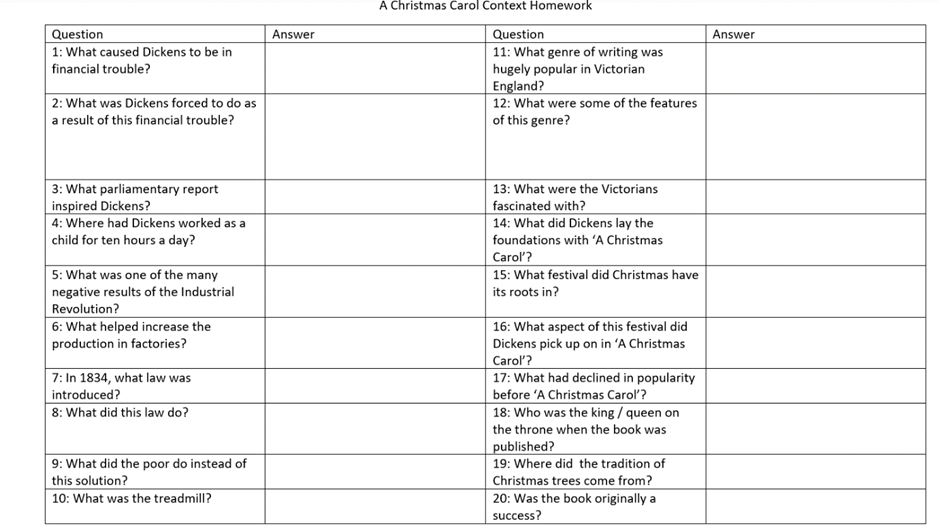
Then, I start the next lesson with a test. The link is below.  https://www.dropbox.com/s/mehkq1sxgncziiq/11%20Homework%20Questions%20to%20Context%20Video.docx?dl=0


This document is used repeatedly over the course of GCSEs. It forms revision and works as a constant reminder of key threads in the story. Initially, we throw the first copy away as students get quite a few wrong on the first go. The next time we do it, about a week later, I get them to make it neat as it will be the one that stays in their books. 


I start with this approach rather than use lots of exploratory texts, because students need a grounding of knowledge in the first instance. Whilst I think it is lovely and nice to show a few texts related to the period, it is rather ‘pin the tail on the donkey’. I could spend a lesson exploring hoping students would pick up attitudes towards class or I could tell them that attitudes towards class was an issue and then get them to explore how that idea is developed, explored in a painting or text. 


Step 2 - building the writer 


Unless you routinely get students to salute and bow to an image of the writer, the writer is a ghostly presence in the room. Some can see him/her. Others cannot. English teachers need to help students form a construction in their heads of the writer. They need a construction of the writer that makes them seem like a real person. Someone with an active presence in the text and the lesson. We are reading that writer’s manifesto. 


To construct that writer, I use the context sheet. If this was the world you were growing up in, what would you think? What would you want? What would you do in your writing to make society change? 


From this, we are able to construct ‘a construct’ of the writer. Of course, we are making inferences. 


Dickens was… 

  • Protective of children and saw children as losing their childhood 

  • Lost his childhood and so didn’t want others to lose theirs 

  • Angry that there were very few options for the poor 

  • Felt that the government wasn’t doing enough to help the weakest 

  • Conscious of how money affected society 

  • Felt that money controlled all aspects of our lives 

  • Angry that the rich were profiteering from the poor 

  • Interested in politics and read government reports 

  • Aware of how easy and quickly someone could become poor 

  • Aware of how people are determined to stay rich


From this, we had constructed an idea of this person. Students had an idea of who Dickens was as a person. They had this mantra for the book: 


Dickens thought Britain was broken and saw that his book could be the message to fix it. 


It became the default response when reading the text.  


Why does Dickens make the setting cold and foggy? Because Britain was broken, Dickens wanted to suggest how cold society was. The fog symbolises how they couldn’t see the problem and so there was no sense of things improving.  


By securing an initial understanding of the writer, we have something to frame ideas around. Therefore, their inferences developed and extended throughout the reading of the text. They’d start understanding that Dickens cared for the poor, but notice how he wasn’t really against the rich. But, what they had was a starting point to build inferences around the writer’s intent, which they can use to build and create their own. If students have knowledge of the primary intent, then they can explore secondary intentions. 


We spend so much time on character construction that we fail to address the biggest thing we want students to talk about - the writer. 


Step 3 - exploring the text 


Now that we have some threads to work with, I return back to this sheet and the construct of the writer routinely when looking at the text. They have a compass to guide their thinking and to work with. We put a lot of stock on their memory, but whilst reading a text we need to keep working on building connections. After reading a section, I will get students to link to the context or construct somehow. Or, I will start the reading with the idea from the construct: We know Dickens was political and supportive of the poor so what is he trying to do in this section? Politically? Socially? 


We talk about the writer as a person we are familiar with. As if he has just stepped out of the classroom and we are talking on his behalf. There is a presence in discussion. He isn’t an afterthought, which the teacher has to keep returning to when analysing the text. He is a fully rounded person to them. 


How we use knowledge is important in English. However, I think we need to use it carefully. Knowledge can build more knowledge, but we need to think more about how that knowledge builds. We need to work on demystifying the writer and we need to help students to form and create inferences on their thoughts, feelings, ideas and perspective. The biggest problem students have is talking about the writer’s intent. That’s because they have no concept of writers as real people. Let’s start helping students to see writers as real people, even if they might have been dead for a few years. Inference works on knowledge and we have to work on the two aspects in lessons.


Thanks for reading,  


Xris 


Saturday, 7 January 2023

Exploring the Inspector’s smalls - being precise with ideas and quotations

Plays, I think, are quite tricky things at GCSE. The plays available for the exam specs  are either chockablock with interesting language choices or they are so sparse that it takes a heavy duty microscope to find them. ‘An Inspector Calls’ falls into the first camp: a play that’s quite rich for exploring the playwright’s craft. And, this can often be a downfall when studying the text. There’s so much to talk about. 

Shakespeare exam questions tend to be kinder to students because they will provide students with an extract from the play, which they can simply use as a springboard or a fresh pasture to dig for quotations. Exams around plays tend to provide students with just an essay title and that’s just it. So, when students are writing about AIC they are having to mine their memory and their recollections of the text rather than have something concrete and tangible to start with. This leads us to what is fairly rote teaching around plays. Instead of exploratory teaching we rely on teaching around the key characters and the key themes. Therefore, the teaching of ‘An Inspector Calls’ becomes DIY essay kits of each character and each theme. Instead of understanding the play, characters and theme the students are taught what to write on a question on Mr Birling and what to write on the theme of social injustice. Are the exams promoting original thought or are they asking students to recall? 


Don’t get me wrong; I do think students need to be taught quite a bit of knowledge around texts. They need to be taught the writer’s intent, the relationship with the context, the form, interpretations and various other things, but I also think there should be some wiggle room for their own exploration and joining up of aspects, ideas and knowledge. The best students make nuanced and precise links whereas the weakest students tend to repeat what the teacher said. 


Every exam for literature relies on students thinking and forming their own ideas. The problem that English faces is that students see English, at times, like other subjects. That means, when faced with a question, they write everything they can remember about that topic. We see that in English with essays. Students write everything down about Mr Birling and so we tend to get lots of generic comments or soundbites about the character. The reliance is on the knowledge and what they can recall. There is no room for moulding, shaping  and exploring ideas. Good students take the knowledge they have and do something meaningful with it. 


Precision in thought, knowledge, ideas and quotations is what is needed for the higher bands. We can teach students some precise knowledge, but teaching precise thought isn’t so easy. That’s why I changed my approach to ‘An Inspector Calls’ a few years ago. The reliance of generalised thinking / knowledge / quotations was creating generalised essays. Therefore, I asked myself how I could make students more precise with their thinking / knowledge / quotations that didn’t rely on me teaching exam essay after exam essay. 


To start off with, I read the whole play with the class and used Stuart Pryke’s brilliant cold read questions.  That provided students with a good understanding of the plot, ideas and key concepts. Then, instead of slavishly going through the whole text, we looked at some choice quotations in order of their appearance in the text. There were about nine to ten for each act. The quotations weren’t ‘big quotations’ that everybody must know, but quotations that reveal something about the character. They might reveal their attitude towards something or their motivations or even some personality aspects.


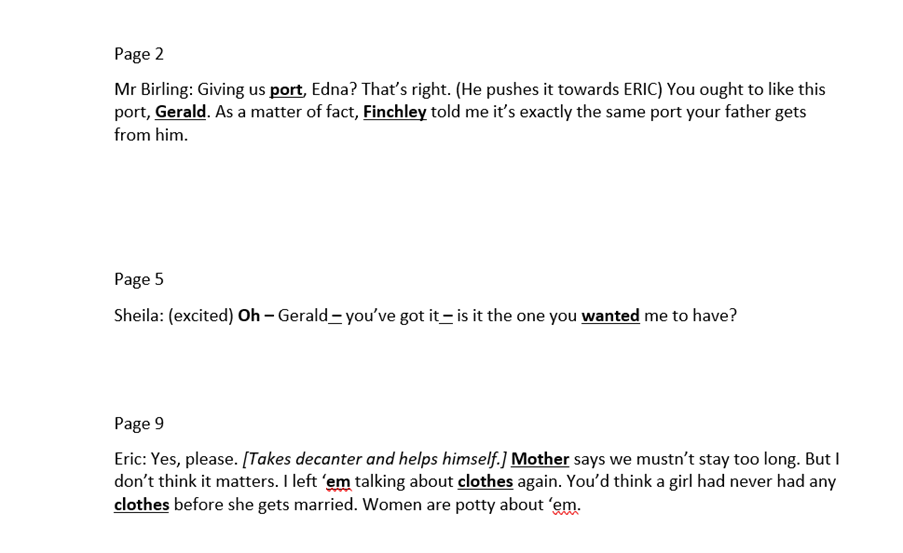
Now, instead of presenting the quotations to students and asking them to play ‘hunt-the-thimble’ of language techniques, we highlighted some interesting choices of language used in the quotation. They look a bit like this: 


We often talk about cognitive overload, but looking at dialogue in a script is overwhelming for me so it must be overwhelming for students too. There’s so much to filter out. We tend to use questions to direct students to bits of interest, but even then it is quite hard for a lot of students because they have to filter out quite a bit of stuff. For me, this really helped to channel the thinking. Of course, we did go back to the script, but we had a starting point which was narrow, focused and without distractions. 

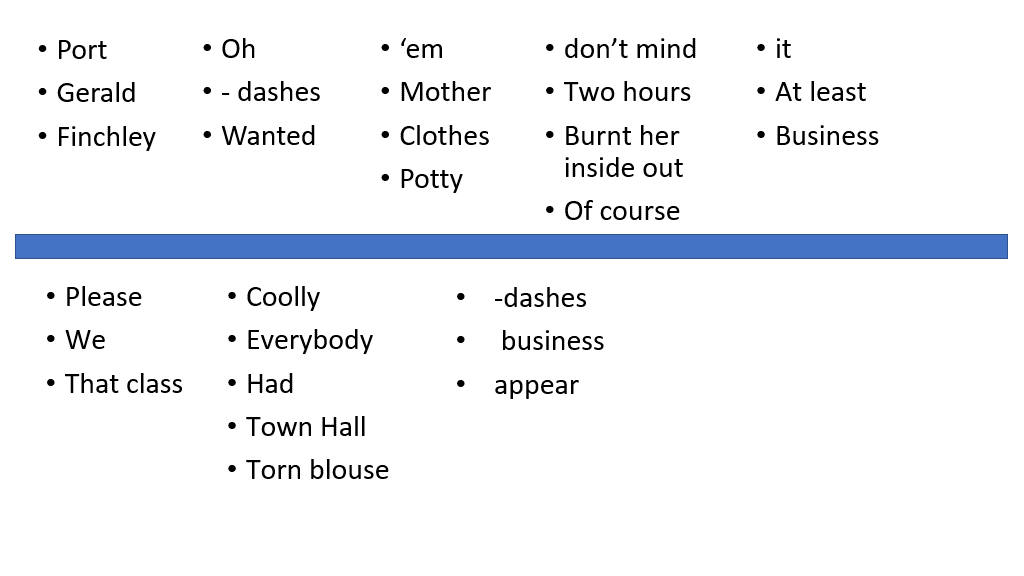
We’d then take each line of dialogue at a time, exploring what those choices meant and what they make us understand.  We discussed the use of ‘port’ and how it represented Birlings desire to be seen as ‘old money’. We mentioned how Birling engages with Edna in conversation, which shows how he still lacks the manners and sophistication of the higher classes. We explored why Birling pointedly mentions Gerald’s name and how Birling is so desperate to build a connection that he is forcing the issue. Finallally, we chatted about Birling’s use of name dropping and how that differs from Gerald's lack of name dropping in the story. The great thing about this was that we were able to explore language choices in such a way that it was exploratory and probing rather than interrogative. Students listen and question language choice regularly each day, yet we don’t build that level of linguistic exploration to dialogue in plays. Plays tend to be seen as just a novel without the description in it. They are not seen as real conversations. Conversations where people contradict what they say with the tone or word choice they use. 


For me, the beauty of a more simplified initial exploration of the text meant that students were starting with a probing way of seeing the text. The fact that we could show how an interpretation can be built from simply Sheila describing the ring as being something Gerald ‘wanted’ was so empowering for students. Quotation learning and learning large quotations is problematic with the new GCSEs. Yes, students need quotations and knowledge of the texts, but they don’t need thirty behemoths to learn to succeed. Instead, they need lots of little, powerful quotations that they could string together to form an argument. One student linked Sheila’s use of dashes and Gerald’s ‘wanted’ to explain how Sheila is devoid of freedom and independence. The dashes reflected her inability to form logical thoughts. 


As we continued across the play, we started noticing patterns in the language. Characters would dehumanise or humanise Eva depending on moments. The Inspector dehumanises Eva to shock the characters in relation to their actions, whereas Birling and Gerald dehumanise Eva to distance themselves from the situation. Gerald even plays around with who he dehumanises and when it suits him he dehumanises the prostitutes in his storytelling so that he can humanise Eva and present himself as the lovely ‘knight in shining armour’. We also noticed other linguistic tricks used by the characters, because the language choices were at the forefront of the exploration. 


Then, as we finished each act we worked on recalling the interesting choices we noticed. 


Once we had jotted the choices that they could recall, we thought about formulating essays around a character or theme. What choices could we use to frame a discussion on class? From the beginning of reading the text, we were looking at supporting arguments with precise choices. The reading of the play coincided with the building up of their knowledge around choices. Students were able to use precise evidence to formulate opinions about a theme or character from an early stage. We rewarded students for choices outside the ones provided. 


Interestingly, the approach had a snowball effect. It provided them with the confidence to explore the choices thoughtfully in dialogue, but it also allowed them to see connections and patterns. The clarity was there from the start. They built on their existing knowledge and saw repetition later in the text, which allowed them to triangulate their thinking and interpretations


Here are links to the documents we used: 


Act 1 : https://www.dropbox.com/scl/fi/q0le3okkj56u6iydvokyo/AIC-ACT-1.docx?dl=0&rlkey=aphl1963qxp0lk69350pcm6w9


Act 2: 

https://www.dropbox.com/scl/fi/hwjwtjkwss9ge61a6tmt2/AIC-ACT-2.docx?dl=0&rlkey=q8423wrioifw9mm3qd54e2e0s


Act 3: 

https://www.dropbox.com/scl/fi/90y8r88997gvob6u7g1pr/AIC-ACT-3.docx?dl=0&rlkey=k82ratca7mfg7cctatjshhhba


Quotation learning is problematic in English and I think it needs lots of thought in how we do it. All too often, we rely on the ‘pin the tail on the donkey’ approach. We’ll just learn loads of quotations with the hope that one will hit the donkey’s backside. Thoughtful, intelligent and meaningful quotations are much more beneficial to formulating an essay than a bazillion massive quotations. I fear that we are overloading students with quotations for the sake of learning quotations. Think of Sheila’s discussion of Alderman Meggarty. She talks ‘coolly’. That one word encapsulates how Sheila has accepted male violence on women. Sheila who is usually so emotive is so unemotional at this point in the story. Sadly, she has desensitised herself to it. 


I, personally, have enjoyed teaching ‘An Inspector Calls’ this way, because it has put interrogation at the heart of learning. Yes, we have looked at larger sections, but starting with this probing thinking from the start has really helped us to understand characters, choices, ideas and themes precisely. 


What student doesn’t like probing the language of a teacher? As teachers, we are mindful of how a slip of the tongue can get us into ‘hot water’. We are careful about what we say and how we say it, because we know students might pick up on the choice we made. Naturally, students are attune to this pedantic language analysis. We all are. We just don’t explore it enough in lessons. 


Thanks for reading, 


Xris 


Saturday, 1 December 2018

'An Inspector Calls' is a play, lovie, darling!


For years, I have really struggled with the exploring and teaching of the genre of ‘An Inspector Calls’. It’s not that I think it is without genre, but I think the genre is questionable and particularly vague.

Yes, the play has the trappings of a murder mystery play. Yes, it has some elements of a ‘well-made play’. But, arguably, there is much about the play that doesn’t fit these types of story, and play. The play does seem like the ending of Agatha Christie novel with the Inspector (Poirot) working through the possible motives for the death and eliminating each character in turn by revealing their connection and motive to the deceased or soon to be deceased. Yet, there isn’t a murder. The play does seem like a ‘well-made play’ because structurally the play works like one. The majority of action has happened before the start of the story and there is a twist at the end of the play. Yet, most ‘well-made plays’ tend focus on characterisation and a woman’s dilemma in love.

For me, this question of genre has really stuck with me. Each time I hear things about the genre of ‘An Inspector Calls’ I wince. It just doesn’t feel right to me. Until, I had a thought about drama and the styles of theatre common at the time the play was written. What if we are looking at ‘An Inspector Calls’ from the wrong angle? What if our obsession with pigeonholing the story has made us forget two major styles of theatre at the time? On one side, you have natural theatre with the likes of Ibsen attempting to recreate realistic people exploring real problems in real time. And on the other side, you have Brecht with Epic theatre exploring unrealistic story telling with real ideas about life and society at its heart.

What if ‘An Inspector Calls’ isn’t actually a naturalistic play but a Brechtian style play instead?  Stay with me on this one. I have quite a few examples to prove the point.


[1] The lighting starts of ‘pink’ at the start of the play and becomes ‘harsh’ when the Inspector arrives.

I have had quite a few discussions with students and teachers on this one, but there is no explicit reference to the colour white, but there is a general assumption that the lighting goes white when the Inspector arrives. We subtly go from a soft, naturalistic colour to a harsh, bright, revealing colour. The colour white is important in Brechtian theatre because white light reveals the truth and prevents things from being hidden. White light ‘illuminates the truth’ – Bertolt Brecht.

I’d be bold to suggest that there is a specific movement between the natural to the Brechtian approach through the lighting. It’s the only lighting effect in the play really. The play opens up as natural theatre and the arrival of the Inspector Goole turns the play into a different type of theatre altogether.


[2] The characters are repulsive.

Personally, I don’t like the characters: I think they are purposefully repulsive and unpleasant. I’d even say that Priestley goes out his way to make us dislike them. Brecht, as he terms it, uses the verfremdungseffekt in his play. A number of approaches to distance the audience. He actively works to avoid any connection the audience can have with the characters. Several devices are used to distance us from the characters and events unfolding. The purpose of this is to make the audience think rather than feel. If people are feeling things for characters, they are not thinking. For that reason, I think Priestley is distancing us from these characters. Eric is surely and snappy. Sheila is smug. Mr Birling is pompous. Mrs Birling is self-righteous. Gerald is privileged. They all have unpleasant characteristics and personality types. All designed for us not to feel. We are made to think about these characters and not feel. There is nothing, if I am honest, for us to connect with the characters emotionally. Furthermore, they are character types rather than ‘real people’. They are two-dimensional. They are ciphers. They are symbols rather than real people. They are there to clearly represent a part of society rather than act as real people.

It comes to something when you empathise with Edna with only a few lines than the whole cast with pages of dialogue.


[3] Eva Smith is constantly changing

Brecht has other known theatre devices to distance the audience from the character, but I say Priestley uses his own approaches to create the same effect. Eva Smith is never on stage. This purposeful omission in the play helps to distance us from the character. She has no face or body in the play. She is an idea. A thought. And, not a real character for the audience.

To aid this distancing effect, we have the character constantly changing. She is a worker. She is a shop worker. She is a lover. She is a soon-to-be-mother. Her identity changes constantly in the play. Even her name changes several times in the play. Therefore, it is understandable when students consider how there could be more than one person. The theory that the Inspector changes the photograph isn’t just one made by the characters in the play, but one that is often discussed in the classroom.  

The recent BBC version of the play was interesting and it highlighted to me this clear distancing effect. The version places Eva Smith everywhere in the story. On the cover. In the trailer. In the opening. In the middle. At the end. She is visible. Therefore, we care and feel for her situation. We feel rather think as a result of this. The BBC version probably gave her own musical theme tune of the film’s musical score. And, we all know what the purpose of music in television is nowadays – a way to make us feel for the characters. Something, I reckon Priestley didn’t want us to do. If we feel, we stop thinking.


[4] How she dies   

Death is never a laughing matter, but there is almost a pantomime approach to death in the story. The way she dies is considerably dramatic and over the top. I am not an expert on suicide in the Edwardian age, but the drinking of bleach, I think, wasn’t a common approach. In fact, I’d suggest out of the options a woman could have used at the time, drinking bleach would be the least obvious one to use. She gets a violent death to avoid sentiment and emotion. Her death isn’t beautiful and  drawn-out (like Dickens’ characters), but blunt, violent and hard to imagine. I’d even say that the ‘drinking of bleach’ is used because we don’t want to imagine that death. We are socially comfortable with visualising some deaths, yet a car crash or a particularly violent death is not one we want to imagine. Therefore, we mentally avoid it.


[5] Titanic

The Titanic is ‘unsinkable’ and there will never be a war are two predictions at the start of the play that make some in the audience chuckle. Their inclusion is always seen as the arrogance of the character and a clear example of dramatic irony. What if their inclusion is actually breaking down of the fourth wall? They are ‘knowing jokes’ to the audience. They make the audience aware that this is a play and a construct and not real life. A bit like when Buffy includes cultural references like Scooby Doo in the dialogue. It is subtle, but it is interesting when looking at the rest of the play, because it doesn’t happen again. We even get several mentions to playwrights:  we have a playwright mentioning playwrights in a play. It is all becoming a bit post-modern.

I’d say that these cultural references are, therefore, purposefully used her to make us aware that this a play and not real life.


[6] Stage directions

I have read quite a few plays in my time and there are very few plays that have the same amount of stage direction that ‘An Inspector Calls’ has. In fact, it is incredibly annoying from a teacher’s point of view, because every line includes precise direction as to how a line should be read.

I studied quite a bit of drama at university and one of the things actors do is work out for themselves how to read a specific line. My drama scripts from university is full of notes on how a line should be said or where I should pause in a line or even when I need to place emphasis on syllable. Priestley has given actors a step by step guide to the reading of the lines. This, dare I say it, could be so that actor doesn’t seek a ‘truthful’ or ‘natural performance’ but a one that is structured and formulaic. It’s an attempt to reduce a natural performance.   


[7] Inspector Goole

For me, there are two type of characters in the play. First there are the symbolic ciphers. The main cast of characters. And, then, there is Inspector Goole. He is a complete contrast to the rest of the cast and, in my opinion, the closest character to a Brechtian character. A character whose role is to tell the story. A character who is designed to make us think. He is the character who turns the story into a parable. He is our narrator. He tells the story.

For years in the classroom, we have debate over the character. Is it a ghost? Is it God? Is it the playwright? Now, I’d say it is a Brechtian character designed to move us away from naturalism. Note how the Inspector stops the emotional journey of characters. We never get poignant, meaningful character moments. Instead, we get the Inspector breaking it up by showing a photograph to characters. Quick show them a photograph before it gets emotional and natural.

The name alone is also cartoonish. It symbolises his unnatural role in the story telling. He isn’t a real person. He is something fantastical. Something of no substance.

Even the Inspector’s speeches and comments throughout the play are largely social comment.

“…but there are millions and millions and millions of Eva Smiths and John Smiths left with us, with their lives, their hopes and fears, their suffering and a chance of happiness, all intertwined with our lives and what we think and say and do.

He is a walking soundbite for political ideas. Is he a realistic character? No. I can’t imagine him having several failed marriages and a drinking problem. In fact, there are very few character touches. That’s because his role is largely the narrator. A narrator who every so often talks to the audience about the political message behind the story.  


[8] Setting the play in Edwardian England

For years, we have taught students that the Edwardian setting is used as a sense of nostalgia and to highlight how the old class structure was detrimental society. What if the selection of a time before war is a purposeful attempt alienate the audience? The world presented in the play isn’t a world that the audience is living in. It is remote from their own experience. It isn’t their daily experience of life. It is incredibly far removed from their own life to be alien. Two World Wars helped to blot that memory.

Plus, the general consensus after a conflict is to look at building the future. A desire to be positive even when the situation is terrible. Instead of focusing on the here and now, or the future, we get a focus on what was destroyed.  After bombing, death, fear and sacrifice, we get a picture of a time when that hadn’t happened yet. The past is distancing the audience from the now. How can the feel for characters who have no idea of the experiences the audience have lived through? Another reason why the audience might find the characters repulsive.   


[9] Pauses

If you are familiar with naturalistic theatre, then you’ll be familiar with pauses. In fact, lots of them. Natural theatre tends to have lots… of… pauses…because real life involves characters thinking, considering and wondering what to say next. In ‘An Inspector Calls’ there tends to be very few pauses. What we have as a result of this is a bombardment of plot points and character’s talking. There’s no room to understand the characters. We aren’t given little character moments. We don’t see Sheila’s unconditional love for Gerald in a small pause after something Gerald says to her. We don’t see those touches that make the characters real. The depth. The subtleties. The tiny nuances are missing. If you want to develop a character, you slow the plot. Therefore, in an attempt, to stop us feeling we are given less to feel about. We get the equivalent of modern day films. We get three acts of CGI storytelling without the slow bits where we understand the characters.

There are just no slow bits.


So, where does this leave us with the play? For a start, I don’t think people to should be citing that the play is Brechtian. Labels are bad. Boo. So, don’t for a start to label the play as Brechtian. I think the play has Brechtian elements, but there are many elements missing too. The key thing I think students need to possibly think about is the audience’s relationship with characters and events on stage. Are we meant to feel something? Or, are we meant to think something? That perspective depends on your opinion on whether Priestley is distancing from events and characters or not.

I studied English and Drama at university - yes, I am one of those people. I think the understanding of Brecht will help teachers to teach ‘An Inspector Calls’. Students don’t need to be quoting Brecht, but if we teach plays from a place of knowledge, we’ll help students to understand drama better.


Thanks for reading,


Xris