Plays, I think, are quite tricky things at GCSE. The plays available for the exam specs are either chockablock with interesting language choices or they are so sparse that it takes a heavy duty microscope to find them. ‘An Inspector Calls’ falls into the first camp: a play that’s quite rich for exploring the playwright’s craft. And, this can often be a downfall when studying the text. There’s so much to talk about.
Shakespeare exam questions tend to be kinder to students because they will provide students with an extract from the play, which they can simply use as a springboard or a fresh pasture to dig for quotations. Exams around plays tend to provide students with just an essay title and that’s just it. So, when students are writing about AIC they are having to mine their memory and their recollections of the text rather than have something concrete and tangible to start with. This leads us to what is fairly rote teaching around plays. Instead of exploratory teaching we rely on teaching around the key characters and the key themes. Therefore, the teaching of ‘An Inspector Calls’ becomes DIY essay kits of each character and each theme. Instead of understanding the play, characters and theme the students are taught what to write on a question on Mr Birling and what to write on the theme of social injustice. Are the exams promoting original thought or are they asking students to recall?
Don’t get me wrong; I do think students need to be taught quite a bit of knowledge around texts. They need to be taught the writer’s intent, the relationship with the context, the form, interpretations and various other things, but I also think there should be some wiggle room for their own exploration and joining up of aspects, ideas and knowledge. The best students make nuanced and precise links whereas the weakest students tend to repeat what the teacher said.
Every exam for literature relies on students thinking and forming their own ideas. The problem that English faces is that students see English, at times, like other subjects. That means, when faced with a question, they write everything they can remember about that topic. We see that in English with essays. Students write everything down about Mr Birling and so we tend to get lots of generic comments or soundbites about the character. The reliance is on the knowledge and what they can recall. There is no room for moulding, shaping and exploring ideas. Good students take the knowledge they have and do something meaningful with it.
Precision in thought, knowledge, ideas and quotations is what is needed for the higher bands. We can teach students some precise knowledge, but teaching precise thought isn’t so easy. That’s why I changed my approach to ‘An Inspector Calls’ a few years ago. The reliance of generalised thinking / knowledge / quotations was creating generalised essays. Therefore, I asked myself how I could make students more precise with their thinking / knowledge / quotations that didn’t rely on me teaching exam essay after exam essay.
To start off with, I read the whole play with the class and used Stuart Pryke’s brilliant cold read questions. That provided students with a good understanding of the plot, ideas and key concepts. Then, instead of slavishly going through the whole text, we looked at some choice quotations in order of their appearance in the text. There were about nine to ten for each act. The quotations weren’t ‘big quotations’ that everybody must know, but quotations that reveal something about the character. They might reveal their attitude towards something or their motivations or even some personality aspects.
Now, instead of presenting the quotations to students and asking them to play ‘hunt-the-thimble’ of language techniques, we highlighted some interesting choices of language used in the quotation. They look a bit like this:
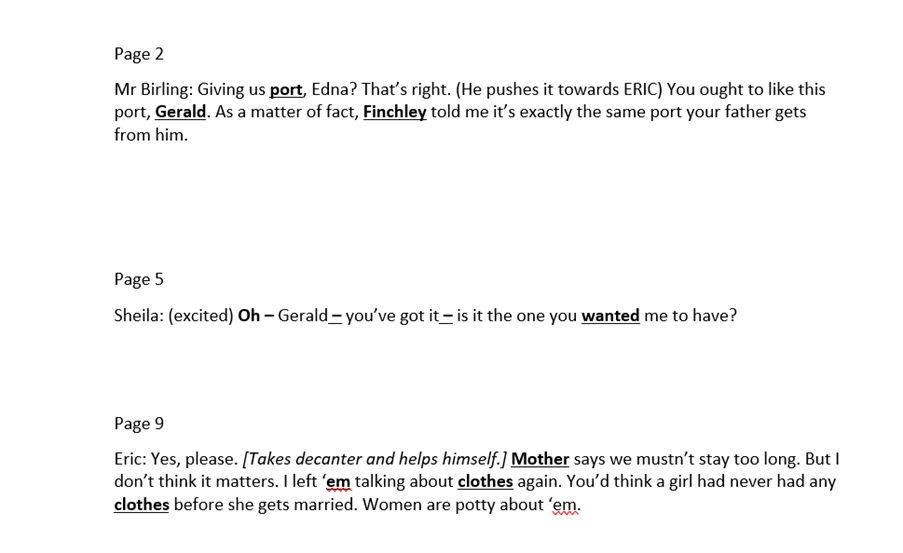
We often talk about cognitive overload, but looking at dialogue in a script is overwhelming for me so it must be overwhelming for students too. There’s so much to filter out. We tend to use questions to direct students to bits of interest, but even then it is quite hard for a lot of students because they have to filter out quite a bit of stuff. For me, this really helped to channel the thinking. Of course, we did go back to the script, but we had a starting point which was narrow, focused and without distractions.
We’d then take each line of dialogue at a time, exploring what those choices meant and what they make us understand. We discussed the use of ‘port’ and how it represented Birlings desire to be seen as ‘old money’. We mentioned how Birling engages with Edna in conversation, which shows how he still lacks the manners and sophistication of the higher classes. We explored why Birling pointedly mentions Gerald’s name and how Birling is so desperate to build a connection that he is forcing the issue. Finallally, we chatted about Birling’s use of name dropping and how that differs from Gerald's lack of name dropping in the story. The great thing about this was that we were able to explore language choices in such a way that it was exploratory and probing rather than interrogative. Students listen and question language choice regularly each day, yet we don’t build that level of linguistic exploration to dialogue in plays. Plays tend to be seen as just a novel without the description in it. They are not seen as real conversations. Conversations where people contradict what they say with the tone or word choice they use.
For me, the beauty of a more simplified initial exploration of the text meant that students were starting with a probing way of seeing the text. The fact that we could show how an interpretation can be built from simply Sheila describing the ring as being something Gerald ‘wanted’ was so empowering for students. Quotation learning and learning large quotations is problematic with the new GCSEs. Yes, students need quotations and knowledge of the texts, but they don’t need thirty behemoths to learn to succeed. Instead, they need lots of little, powerful quotations that they could string together to form an argument. One student linked Sheila’s use of dashes and Gerald’s ‘wanted’ to explain how Sheila is devoid of freedom and independence. The dashes reflected her inability to form logical thoughts.
As we continued across the play, we started noticing patterns in the language. Characters would dehumanise or humanise Eva depending on moments. The Inspector dehumanises Eva to shock the characters in relation to their actions, whereas Birling and Gerald dehumanise Eva to distance themselves from the situation. Gerald even plays around with who he dehumanises and when it suits him he dehumanises the prostitutes in his storytelling so that he can humanise Eva and present himself as the lovely ‘knight in shining armour’. We also noticed other linguistic tricks used by the characters, because the language choices were at the forefront of the exploration.
Then, as we finished each act we worked on recalling the interesting choices we noticed.
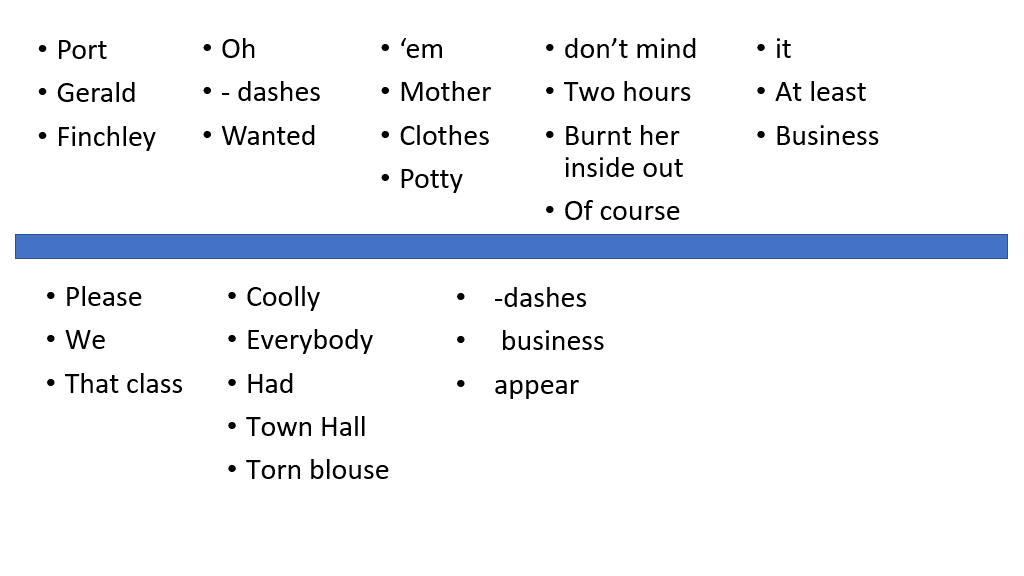
Once we had jotted the choices that they could recall, we thought about formulating essays around a character or theme. What choices could we use to frame a discussion on class? From the beginning of reading the text, we were looking at supporting arguments with precise choices. The reading of the play coincided with the building up of their knowledge around choices. Students were able to use precise evidence to formulate opinions about a theme or character from an early stage. We rewarded students for choices outside the ones provided.
Interestingly, the approach had a snowball effect. It provided them with the confidence to explore the choices thoughtfully in dialogue, but it also allowed them to see connections and patterns. The clarity was there from the start. They built on their existing knowledge and saw repetition later in the text, which allowed them to triangulate their thinking and interpretations
Here are links to the documents we used:
Act 2:
Act 3:
Quotation learning is problematic in English and I think it needs lots of thought in how we do it. All too often, we rely on the ‘pin the tail on the donkey’ approach. We’ll just learn loads of quotations with the hope that one will hit the donkey’s backside. Thoughtful, intelligent and meaningful quotations are much more beneficial to formulating an essay than a bazillion massive quotations. I fear that we are overloading students with quotations for the sake of learning quotations. Think of Sheila’s discussion of Alderman Meggarty. She talks ‘coolly’. That one word encapsulates how Sheila has accepted male violence on women. Sheila who is usually so emotive is so unemotional at this point in the story. Sadly, she has desensitised herself to it.
I, personally, have enjoyed teaching ‘An Inspector Calls’ this way, because it has put interrogation at the heart of learning. Yes, we have looked at larger sections, but starting with this probing thinking from the start has really helped us to understand characters, choices, ideas and themes precisely.
What student doesn’t like probing the language of a teacher? As teachers, we are mindful of how a slip of the tongue can get us into ‘hot water’. We are careful about what we say and how we say it, because we know students might pick up on the choice we made. Naturally, students are attune to this pedantic language analysis. We all are. We just don’t explore it enough in lessons.
Thanks for reading,
Xris
