Showing posts with label Exam. Show all posts

Sunday, 21 April 2024

Cognitive Buckaroo with Non-fiction

As we get closer to the end for our Year 11s, it is so common for us to throw (metaphorically)  everything and the kitchen sink at them. As they leave classrooms, we pile them up with different sheets to help. Each lesson tries to cover large feats such as the whole of a Shakespeare play in an hour. All fifteen poems in two lessons. Whole language papers in an hour. When we treat students like educational versions of Buckaroo, then there’s no wonder some students struggle. We are piling things on top of things. Cognitive overload is generally common sense. If I give too much to students, it isn’t effective. 


The problem in English teaching is that we have this strange relationship with cognitive overload. We see nothing wrong with spending a whole lesson exploring a line in poetry or even seven words in a line from soliloquy, but for non-fiction we treat it like something different. In fact, ‘exploding a quote’ is almost a standard lesson for literature lessons, yet for non-fiction we teach at speed  like there is no tomorrow. 


There are two things students need to generally know about non-fiction: 


[1] Writers openly say what they think and feel in non-fiction unlike in most fiction. Therefore, they need to actively work harder to spot the implied thoughts and feelings. 


[2] A writer’s attitude towards a topic will often change in a piece of writing. They might grow to like or dislike something. Or, they may even change their perspective on things. 


[3] Unlike fiction, non-fiction texts often have many narrative threads. 


When reading a piece of fiction, you are generally building up a jigsaw of the story, but this is quite different for non-fiction because you are building up more jigsaws. What the writer thinks/feels? What is the situation the writer is in? What is the topic? These contrasting threads are hard to piece together, because there isn’t a clear narrative to hold them together. You can see how exam boards pick mostly ‘narrative’ style pieces of non-fiction to help students. At least, if there is a narrative of a boat breaking down, then a student can follow a text logically. 


Students have a problem with pinpointing things in non-fiction because of cognitive overload. Fiction usually has some clear things in it that clearly standout. We usually rely quite accurately with students to spot in a poem or a story what is interesting. That’s not so easy with non-fiction. In non-fiction there is a massive amount of cognitive overload because so much is competing for attention. A feeling in the first paragraph is of equal importance to a feeling in the second paragraph. That’s why it is so important to help students to work on reducing cognitive overload of a text. 


I am indebted to the fantastic Laura Webb and her resources for this. I’ve tweaked it a little to help model things to students. I’ve included the worksheet here. We model to students how you can take three sentences from the text to form a good idea of what is going on in the text. This one from Laura is about begging. 


First, we take three lines from the text. One from the beginning. One from the middle. One from the end. 


Source A

I come now to speak of the other class of begging impostors.

I am sure the number has not diminished since then; my impression is, that it has, on the contrary, considerably increased.  

This will give the immense sum of 7,5001. per week, or 350,0001. per year, which these persons levy on a charitable public. 


Source B

And we are using a 200-year-old law to lock up homeless addicts for begging, in some cases sending them to already overcrowded prisons.

I met a guy in Brighton who makes about a fiver a day – the most he has ever made is £30.

Luke, a homeless man I met there, a former chef, is now an addict with mental health issues. The sergeant had little sympathy.


We explore the tone. What is the tone of each line? What causes the tone? Why do you think the writer uses that tone? 


From the example, students might pick up the snobbery and disgust of the phrase ‘other class’ or the adverb 'considerably’ reflecting the writer’s fears that this problem is out of hand in the first source. Students might pick up the varying examples of pity towards beggars by making things personal with a name or how little they make in the day. 


From this, students can actually make a reasonable comparison in terms of feelings. Both texts hate something. Source A hates the beggars as he feels they are criminals. Source B hates the attitude to the police and how the judicial system treats them. We could also make a connection about pity too. Source A pities the ‘charitable’ people who give money because it is wasted. Source B pities the beggars for they have some deep seated mental health issues.  


From three lines alone, students can form clear ideas and can develop explanations around language choices. They can look at the rest of the text for ideas and technique,  but they have a starting point with non-fiction. And that is where the rub is. Students cannot tackle a whole text. They don’t do it for poetry or fiction, but yet when it comes to non-fiction they feel they need to. Half their time is spent searching for the bits to write about rather than thinking about the text. All non-fiction is seen as a block of text. We need to help them break it down. If we lighten the load a bit, the horse won’t buck and will get to where he / she needs to go. 


Thanks for reading, 


Xris 


Sunday, 28 January 2024

A question of tone and not techniques

In the time I have been teaching, I have seen the teaching of English compartmentalised in so many different ways. And, dear reader, you cannot put it solely at the hands of the GCSE exams. We’ve had the National Curriculum and APP grids along the way. They all attempt to make the subject an easily digestible tick list. When you do that, you see the general focus is one making the abstract concrete. You see limiting writing structures for analysis. You see an emphasis on concrete knowledge like facts around historical context and identification of techniques. We see students able to repeat facts and spot techniques, but they cannot explain why they are used. This then leads to the teacher having to explicitly teach why a technique is used. And, this repeats on and on. 

Tone is the single biggest thing that improves writing and reading across all levels. It is everywhere in our subject yet it is nowhere at the same time. Tone is something that glues words, sentences, techniques and paragraphs together. It is something that connects the reader to the writer. It is something that links the context to the writer’s purpose. It is hidden below the subject of a text and it is the seam of gold that helps students unlock meaning and understanding. Yet, it is something so hard to compartmentalise. Yes, you can name it for sure, but you can’t really define it fully because it sits across so many domains and processes.  

Look at how tone is everywhere in the AQA English exams: 


English Language

Reading 

Paper 1 - the narrator’s tone, the individual tone of characters, the writer’s own tone 

Paper 2 - the tone of the writer is both extracts 

Writing 

Paper 1 - the tone of their characters, the tone of their writing 

Paper 2 - the tone of their writing 


English Literature 


Shakespeare 

The tone of the extract, the tone of the character, the tone of the writer. 


Pre1914 Novel 

The tone of the extract, the tone of the character, the tone of the writer. 


Modern Text 

The tone of the extract, the tone of the character, the tone of the writer. 


Poetry Anthology 

The tone of the extract, the tone of the voice,  the tone of the writer. 

Repeat for the other poem 


Unseen poetry 


The tone of the extract, the tone of the voice,  the tone of the writer. 


Tone is everywhere in English, because it is literally everywhere in life. If students are receptive to the concept of tone, we have a seam of gold to mine in the English classroom. 


The problem in English lessons is that the questions become focused on the microdetails. Specific words. Specific techniques. Why did Dickens describe Scrooge as an ‘oyster’? When exploring that question, we are exploring quite precise knowledge. What is an oyster? What is the symbolism of oysters? If you know nothing about oysters, then you are stuck. Not many students know what an oyster is, so you are on a losing foot from the start.  


When we move the questioning away from microdetail, we focus more on the interconnectivity within a text. Take the following question: How does Dickens create a sympathetic tone in Stave 1? To respond to that question, you have to join parts of the text together, whether they be plot detail or writer’s methods. But, there’s also a personal aspect. The evidence to support the point can vary from student to student. The questioning can then be layered up. Why is Dickens so sympathetic here? What isn’t he sympathetic about? Interestingly, what is empathic about? 


Teaching tone in literature texts is paramount, but it isn’t a concrete thing. There’s more than one technique to show pity. More than one technique to show anger. And so. I’d argue that instead of using pretty empty verbs around the writer when exploring intent, there’s more legs in talking about tone. Instead of talking of what Dickens is challenging in the story, talk about what makes him angry. Anger, of course,  leads to ‘challenging’.  


From a language analysis perspective, starting with tone means you are already joining up parts of the text. How is this extract comical? The use of exaggeration. The word ‘blubber’. The repetition of ‘again’. Then, analysis starts with what makes the exaggeration comical, rather than the tumbleweed moment of ‘What is the reader supposed to feel with this exaggeration?.  


From a writing perspective, teaching students about the subtle types of tone they can use is highly beneficial. The default tone for transactional writing is usually Facebook rant or end of the world apocalypse. The better writers have a breezy and light tone that knows when to pack a punch and when to understate things. 


The starting point is to talk about tone. Talk about awe, frustration, sarcasm, irony, bitterness and so on. Talk about when tone changes. Talk about why tone changes. Talk about why that tone then. Don’t just give a wordbank of tone words. Actually, talk about tone and teach about tone. 


You’d think we’d give tone the same level of respect as full stops and capital letters given that they are in every piece of writing, but we don’t. There’s so much time given to techniques with the hope that students can spot it in the rare occurrence of it appearing in an exam. I can guarantee the text will have a tone. 


Thanks for reading, 


Xris 


Sunday, 12 March 2023

Mock Marking Targets

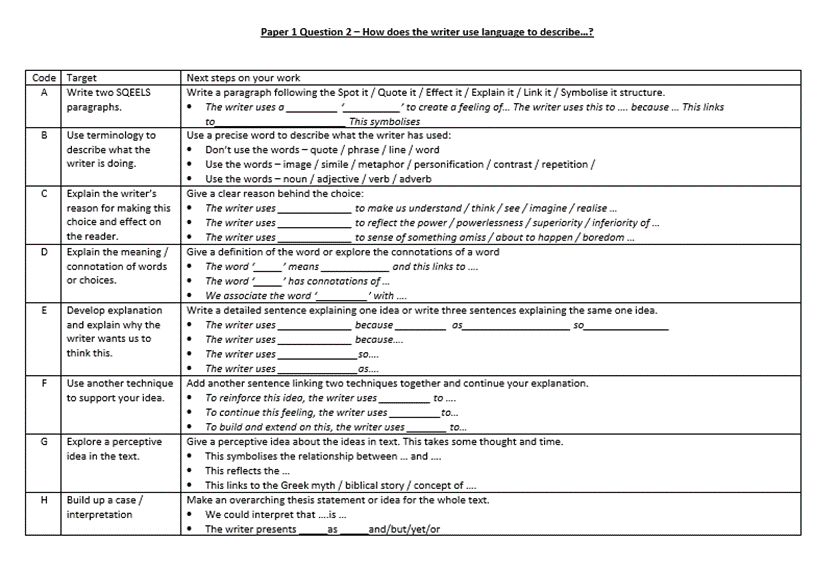
A long, long time ago. I shared some simple targets for marking the English Language exam papers. They’ve saved me hours of time and stopped me from writing endless comments on exam papers. I simply write the code at the end. Students copy out the target and act on it. Obviously if there’s something else I need to comment on then I will write it down. The great thing is that I am able to spot patterns and trends across a class.


It was time for me to update the targets and that’s what I have done. This time around I have added a next step task which focuses on precise next steps. This time around I have used some precise sentences for students to use. 


Feel free to steal, borrow and adapt as you see fit. I hope that it saves someone out there some time. 


Link to Paper 1 marking targets. 

Link to Paper 2 marking targets. 


Thanks for reading, 


Xris


Saturday, 8 January 2022

Semi Skimmed Reading - Reading and approaching unseen texts

For years, skim reading has been a thing. I have seen it used and referred to time and time again. Yet, I think it is the single most damaging skill in English. Ok, I will dial down the drama. Right, it is a dangerous thing when looking at how students read in lessons. Skim reading is quick, superficial and answer focused, but isn’t insightful, perceptive and clever. The problem we have is that in schools the default reading strategy is skim reading. It is the go to. The first step. The emergency button when reading exam papers.

The English exams are all unseen text exams. Even the literature exams are unseen texts. You don’t know what you are going to be reading about regardless if you have read the text. There’s a whole surprise element about things. Gotcha. You didn’t think it would be that?  Because everything is unseen, the way students read the text is so important and here is the problem. English places more emphasis on the text / sources than the questions. Yet, most subjects have a greater emphasis on the question than sources. That’s why students read the question and look for the answer. The default across exams is this process. Look at the question and then look at the source. This is where skimming and scanning comes in. Look at the question and then hunt for the answer. This is where English is far more nuanced and complex. 

English is like painting a picture rather than fox hunting. Yes, you can set the hounds off to look for an answer, but during that process they will have missed lots of interesting and relevant things because they only focused on the scent of one thing. The scent usually is what they are expecting to happen. A painting is a culmination of aspects combined to make the whole. The whole is always more important than the single parts.  


Time and time again I see students fall into this process. Read the question and then search for the answer. If we look across whole cohorts, we see this permeates across all aspects of English. It’s largely why students rarely plan. The fox hunt approach. Quick and fast before you lose the scent. That’s why students waffle with literature responses. They found a scent of something so they need to write it down before they lose it. That’s why students waffle in transactional writing. I better get the scent of an idea down before it fades. Again and again, they do this. 


Texts should be the driving force for understanding and not the question. The questions are only there to see that they really, really understand the text. It is not to show that they really, really understand the question. We’ve got to the point where the question has such a damaging impact on understanding. Students automatically focus on the question because of the school’s collective emphasis on the question first then checking the source for the answer, but we are supporting it even more by putting all the emphasis on the questions and supporting this fox hunting approach to reading. If a student knows the text well, then there isn't that much of a need to spend time looking at how to write the question. Largely, the teaching related to answering the question is making sure their writing emulates a person understanding the text. Teaching exam preparation is largely teaching students visual markers for an examiner to think ‘cor this student knows their stuff’. 


Hiding the questions is key to addressing the problem. Students must ensure they understand the text first, before they even think of the questions. Take GCSE English Language Paper 1. We always look at the text in isolation. No questions. No skimming and scanning. The starting point is reading the text. It isn’t searching for techniques. It isn’t finding every clever thing we can. It isn’t even anything fancy. Read it and make sure we understand it.  


I follow this structure for approaching all texts on the language paper. But, here, I am going to specify Paper 1. 


Step 1 - The letter box - The overview 


Orientating the text is a tricky aspect. It is key for getting the overall text’s meaning. The sooner students understand the context of the story the better. We’ve all read novels where it has taken us three pages to work out an elf’s perspective we are seeing things from  and not the tree’s perspective. Oh, and everyone is dead.


#Who is the protagonist? Who is going on an emotional / physical / spiritual journey? 


#What is the conflict? What is going to cause the drama in the extract? 


#What is the genre of the story? What are the rules and things I’d expect to see with this genre? 


Students look for these markers to build a rough picture of the story. Rosabel. She is poor. Realism. Then, there might be some inferences we can make based on the overview. It always helps to get them to think before they read the extract.   


Step 2 - Read and summarise 


Then, simply I get students to read the text one paragraph at a time. For each paragraph, they come up with a title. This then helps solidify the focus. 


Interestingly, it takes some time to get students to be good at this, because they try to overcomplicate things. They want to sound good from the start. Giving them confidence to say that the section is about the bus is key. This is still orientating around the story. 


Usually, at this stage, students in the past have highlighted forty techniques. The sad thing is that students only really need about four or five good ones. But, like skim reading, how students engage with reading has become warped. We need students to focus on understanding first and that’s what isn’t always happening. 


Step 3 - Track the journey 


Finally, we spend time pulling it all together. I get students to simply draw a table. An eye. A heart. A lightbulb. Then, we track the start / middle / end. 


What does the writer focus on in the start / middle / end? 

What are we supposed to feel at the start / middle / end? 

What ideas are being explored in the text? 


Feelings can be quite a tricky thing to articulate, so often we start with positive / negative and then attach specific emotion after that. Students find it much easier to go negative and then anxious rather than trying to find a word that matches the effect. 


Once students have spotted the focus and the emotions they can then start thinking about what is really going on in the extract. What are the big ideas? We tend to watch numerous short animated films to get them into the habit of exploring these three things. Focus. Feelings. Ideas. Time spent thinking about them now saves time later. 


Now, we get to the questions. They’ve spent about ten minutes on the extract. But, by then, they understand the subtext and explore what the writing is trying to show and the ideas in the text. Ready to think about the question. When we get to this stage, students have a concrete set of ideas to work with, so when they look at Q2 and talk about techniques they can link to ideas and feelings already thought of. They don’t have to hunt foxes. They are starting from a position of confidence. I have something to work with and I can build on it. 


Exams are pretty stressful and students want to do well, but sometimes the approaches they use, and we teach, are counterproductive and far damaging. Skim reading and focusing on the question first are two things I think we need to address in lessons and help students to avoid. These two elements warp the processes in exams to the point that they are damaging. A focus on skim reading teaches students that there are quick and easy answers to find. A focus on the question teaches students that the reading of the source isn’t important. A student will do well if they read the unseen extracts slowly and in a structured way. 


We need to work harder to show students that English deals with things differently than other subjects.The default might be to skim read and look at the question first in other subjects, but that is the worst thing to do for us.


Thanks for reading, 


Xris 


Sunday, 21 November 2021

High stakes exams and mocks – let’s go low, low, low, low

I am surprised that we don’t talk enough about mental health on Twitter and through blogs – especially given that we’d just been through a pandemic. We’ve all been through a challenging experience that even most adults have struggled with. Contrary to media stories, it hasn’t been an extended holiday for teachers. I crave routines and patterns in my life. Only this week, a colleague joked how I love a system. It is true – I love routines and systems in school, and life. Occasionally, I might throw chaos in there by catching an illness or doing something different. We all love routine, secretly. That’s why moving schools is so difficult. Adjusting to a whole new set of systems and rules.  

For the last few years, there hasn’t been any regular routines for students. Instead, they’ve had to live in a world of vagaries. Will they have to go to school? Will school revert to online lessons? Will they have to sit exams? Will the work they do be included in their portfolio for grading? Uncertainty is natural part of life, but it is only a small part of life. The pandemic has made uncertainty a big part of everyone’s life. Instead of the uncertainty of Uncle Ben turning up at the weekend or not, we have the uncertainty of the structure of the week, month, year and our future. Tomorrow is always an uncertainty, but the options for what is going to happen are usually narrowed to a few options. Well, if X happens, we will do Y. If Z happens, then will just do nothing. Therefore, even with uncertain events like the future, there’s still a level of certainty in uncertainty.


When the future lacks a level of predictability, then we become anxious, unsettled and stressed. Take this equation:

stressed teacher + stressed student =  failure


Please be clear: I am not advocating a ‘smile as you teach policy’.  Instead, I am highlighting how we are building towards a toxic situation and we, and I mean all of us, have to do something about. Leaders are anxious because of the uncertainty of things. Teachers are anxious because of the uncertainty of the GCSES. Students are anxious because they don’t know what is and what isn’t important now. Feelings are absorbed. Like energy, they don’t disappear, but are transformed to another feeling or absorbed by someone else. A stressed student looks at the teacher and sees their stress and automatically that heightens their own stress. If the teacher is stressed about things, then it really must be bad. Teachers must be ‘loco parentis’. They must be the stability in situations. The physical stability. The emotional stability.


Teachers can have an impact on the feelings of students and now, more than ever, that’s important. We can orchestrate a sense of achievement, motivation and momentum or we can orchestrate the opposite in what we say and do. I know how I respond to things can have such an impact on what happens in the minds of students. Take these two responses to a class doing badly in an assessment:

[1] I am really disappointed. We spent ages on learning the structure to the question and only two of you remembered to use it in the mock exam.

[2] I get that some of you might be disappointed with your results, but I am not. A few tweaks and you’ll be there. We just need to make sure we remember the structure of the question.


Two ways of address and feeding back to students. One plays on emotional manipulation. The adult is disappointed and then forcing the students to feel disappointed. Then, apportioning the blame to the students. It is the students’ fault for the underperformance and not the teacher.  The other response doesn’t dismiss the feelings of the students but reframes it. Structures the ideas into something positive.

We remember how people made us feel rather than what they say, but in teaching we have to be so careful how we frame things. Yes, we might be disappointed with an assessment, but will sharing my feelings of this improve things?  Once, I worked for a boss who constantly shouted at staff. Not once did that make me work harder or better. Instead, it just made me avoid them. Later, I had a boss who did the opposite: they praised you when you did something really good. That motivated me more. Interestingly, I worked harder for that second boss, because I wanted more praise, than the other boss. I work harder and better with positivity than the negativity. That’s true in the classroom. Students are far more responsive with ‘meaningful positivity’ than negativity. Meaningful because it needs to have some value. Be positive about everything and then you devalue what is truly good. Like most things, it needs to be measured.

I don’t think the teachers are the only things to be mindful this year. I think mock exams are problematic, yet nobody is talking about it.

(stressed teacher + stressed student) x (mock exam x frequency)  =  failure

We have an assessment system that is built around the ‘do or die’ principle. Mocks are not only a depressing thing for teachers to mark, but they are depressing for students. They are either ‘yes, I got the grade I want’ or ‘no, I didn’t get the grade I want’. As much as we work on feedback, mocks highlight if a student is a success or a failure in their eyes. We like to think the students see them as a opportunity to learn, but a few do, but the rest don’t. Most of the problem is the fact that the mocks attempt to replicate the process of the final exams. Instead of the process being about preparation, it becomes replication in all manner of things. We replicate the emphasis, stress and impact of the final exams. Oh, and we do it in a two or three week block. So, in fact, we don’t just replicate the process, we turn it into something worse. The GCSE exams in a fortnight. The final exams are spread over months, yet we ‘in our attempt to help and replicate the experience’ condense it all into a fortnight. We are not replicating here, but creating a different monster.

We need to change the perspective of the mocks in everyone’s heads. Rarely, is it seen as a positive learning experience. No students uses the phrase ‘I learnt from the mocks…’. Students don’t really articulate that idea. Occasionally, teacher will learn from them, but given how many papers are set it is lucky if a teacher can recall their name after the process of marking a bazillion papers. Largely, they are viewed in negative terms. Every mock highlights what they cannot do. We produce lists of what the papers tell us they can’t do. We then build that into our teaching. The whole emphasis is on the negative. We dwell on the negative aspects. In fact, we don’t just dwell, we soak ourselves in the negative parts for months.

A mock is not the final exam. The more we treat it as one, the more problematic they become. Mocks are too high stakes for my liking. The final exam is where they need to be at their best. Everything before then is building to the final exam. A mock, in my opinion, should be centred around what a student can do, rather than what they can’t do. They should be an opportunity to highlight the green shoots. The seeds of success. The buds of brilliance. A student needs to know that they can succeed, yet instead we have mocks geared around high stakes and mistakes. Ideally, what I want students to see is that they need to replicate what they did in these green shoots and apply them to other areas where they are not so successful. A sense of achievement is so powerful. Students, if they do something well, they will repeat it again and again. Why are we not using this element more in education?  Replicating the successes is as equally important as learning from mistakes; otherwise, students learn from mistakes but don’t repeat the early successes.

If we are to help students in these uncertain times, we need to change our perspective on mocks. They should be an opportunity for us to praise and reward the green shoots. They should be an opportunity for us to show students that there are green shoots in their work and with a bit of watering and feeding they could be truly successful in the final exam.

This term, I have started saying the following in class:

Mistakes are good. I need you to make mistakes in mocks, assessments and lessons, because that’s where you’ll learn not to make them again. The only time we don’t want those mistakes are in the final exam and that’s why we are working to learn from them now. We are building to perfection. I want to see some green shoots.

 What teachers say and do changes the stakes for students? What SLT do with mocks changes the stakes for students? The only time we need high stakes is the final exam. That’s where it matters. Everything else is building to that point.

Come on people: search for those green shoots and praise the students for them!

Thanks for reading,

Xris


Sunday, 26 August 2018

Interventions – stop swapping cows and magic beans


I hate the word ‘intervention’. It’s a nasty word that has crept into education. It’s so bad that parents and students are using it now. What interventions have you put in place for my Tiny Tim? By creating the concept of intervention and readily using the word, we have separated things from teaching. We have made it seem like something extra.  We have made it seem like extra work and divorced it from teaching. I am all too aware that the rise in workload and pressure is closely linked to the naming of intervention. We have made it seem like something extra and in addition to teaching.  What did we do before 2012 before schools used the word ‘intervention’?

Intervention is just teaching and I think we need to keep going back to the idea. Intervention is just another word for good teaching. It isn’t something extra. It isn’t magical. It is just teaching stuff and working out the right stuff. We can make millions of choices and we are all working to make the right choices for our students. If we use words like ‘intervention’ we are suggesting that there is a magical cure and a simple solution. If I do X, then they will succeed. If I don’t do Y, then they will fail. Not only are we creating stress with workload, we are creating emotional culpability for a student’  performance. I bet there are teacher kicking themselves over the performance of some of their children. No amount of interventions would have worked, because the student didn’t work hard enough. Yet, we beat ourselves up, because there must have been one magic bean that would have worked to transform them.

Every year I look at results and the key thing I keep going back to is this mantra: the student who works hard gets the results they deserve. I don’t look at students and think that the one lesson on ‘An Inspector Calls’ is the secret to a student getting a grade 8. No, the student got the grade because they listened to me and worked hard. The student did two solid actions. They listened. They worked hard.

We need to rewire our thinking in schools. We need to stop propelling the idea that there is a simple fix. A pure, unrefined solution. We need this at all levels and not just with the students. Students need to work hard and listen to teachers. If they do that, then they will be successful. If we think success is driven by something other than hard work and listening, then we are removing a student’s responsibility from the process. We are actively doing this by propelling the idea of interventions.

This year we changed some parts of our teaching and this proved fruitful and positive in the recent results. But, underwritten behind the changes was the mantra: the student who works hard gets the results. None of the changes were mind-blowing. Here’s just a quick overview:


[1] Scanning mock papers

We had an issue with students going into the exams in 2017 and writing nothing. Throughout Year 10 and 11, we scanned and emailed parents the paper of students who didn’t answer the paper or wrote a paltry effort. We sent a nice email explaining how this level of effort would result in an ungraded paper, which doesn’t reflect their true potential.

The great thing about this approach was that I was evidencing the fact that student wasn’t working hard enough. I have electronic files of the papers as evidence to parents and SLT. It was also blooming immediate. I emailed parents after the mock exam, so the parents can speak to the child and address the issue so that the next mock they did showed an improvement. All students this year completed the papers.


[2] Using apps

There are a number of tools to help students revise and I use the PixLit app for literature revision. This year, I closely monitored the use of the app. The app was a clear marker for me to see if a student is revising. The rest of the time we don’t know what students are doing. I told students that this was going to be the thing I’d use to judge their revision. I then emailed parents if a student hadn’t used it and I spelt out to parents that they were, in my opinion, not revising.

I wasn’t draconian to the point of berating hard working students if they didn’t use it much. Instead I used it to monitor the students who don’t work hard enough and highlight to parents this fact that revision is not happening. I used it as a starting point for discussions and meetings. It was evidence of the students working hard, or not working hard.


[3] Homework booklets

For two terms, I produced a homework booklet for Year 11 students. They had 50 practice questions / tasks from the various papers - I used those terrible KS3 exam papers – and students had to use the booklet. On the front cover was a table for students to tick off the work they had done. Some of the tasks were annotating a poem or writing some example sentences. They were all about thinking rather than writing. I wanted students to practise thinking in response to the questions on the exam paper. Instead of writing a piece, I’d ask students to write plan. Therefore, they were practising again and again the thought processes.

This addressed the issue of giving practice papers and them sitting at the bottom of a bag somewhere. There was nothing for a teacher to mark. They just had to quickly skim to see if the student had completed it or not. We were spelling out how to revise. But, more importantly, we were visually showing how much revision students had done. A teacher and a parent can see how much revision had and hadn’t been done.


[4] Redoing mocks  

After we had marked the mocks, we had highlighted in every class a few students who had underperformed because they hadn’t worked hard enough or they just had a bad day. As a result of this, we asked students to redo the paper at home. The teachers remarked it and (surprise, surprise) the students always did better.

I wanted this to be a genuine concern of students. If I don’t work hard enough, then I will have to redo the paper. Simple as that. I want working hard to be the easy option.


[5] Patrolling the mock exams with my invigilator spies

I ditched the walking-and-talking mocks. We teach the papers thoroughly so a walking-and-talking mocks doesn’t add much value for us, so instead I walked about the desks during the mock exams. I made notes about performance. I observed students with heads on the desks and students who looked visibly stressed and panicky.  After the exam, I spoke to the students about their behaviour.

I think every head of department should patrol mock exams, because it gives you a fantastic overview of a cohort. You see the students and all the problems. You see the students who lose steam and motivation after an hour. You see the top set students writing to the bitter end. It gives me an opportunity to praise students (a simple thumbs up) or put back on track students not working (tapping the desk).

The invigilators are now my spies. They tell me and note down how students perform in the exams. They are there to observe and monitor students. They make great spies and they love telling me about students. They are in the best place to tell us who is working hard.


[6] Extra mock for a few select students

I see no point in doing endless mocks. However, for a select number of students I put on an extra mock after school. With the parents’ support, they did another paper. One more than the rest of cohort. Mainly, I did this for bright boys who were underperforming and students with confidence issues. Students were told that if they did better on this mock, it would replace the grade on their previous mock. The whole ideas was about improving and getting better.

This was also a PR stunt. It told students they needed to do better and that there were selected because they had the potential to be better.   


Stop using the word ‘intervention’ in your school. Teaching is one long piece of intervention. There are no magic beans. The students should be working harder than the teachers. For too long the teachers have been working harder than the students. We need to address this. We need to focus more on making students work harder. We need to be the mirror that reflects the level of student’s work and effort.

Plus, we need to make working hard the easy option in schools and not the other way round.


Thanks for reading,

Xris

Sunday, 13 May 2018

Exam Hacks: Paper 1 Writing


Last year, before the exams I wrote some ‘hacks’ for students. Short little mini lessons or tips to help them get better at answering the question. They often were stylistic choices rather than big ideas guiding how to answer the question. Be clear, these are not about replacing teaching, but supplementing what students already know.


[1] Don’t use ‘crash’, ‘bang’, ‘boing’ or ‘beep’ unless you want your writing to sound like a four year old’s writing.
Instead extend the onomatopoeia with more detail about the sound.

The mutter of …
The moan of …
The rustle of ….
The hiss of ….


[2] Describe the light, reflections or shadows and you can connect things together in a paragraph. It touches everything.
Shadows pass across the various rows of books.
The reflection in the glass shows a couple sat at the table.
Light blinds the trees to the small creatures collecting underneath them.

[3] Repetition is the one technique you probably want to use more than others.
Repetition can be anything – a word / idea / sentence / adjective / phrase. Repetition is sign that you are being playful with your writing.

The cold mist smothered the cold visitors to the park.

Tears fell, tumbled, spilled down her face.

[4] Give the detail that nobody spotted. Spot something minor, insignificant that nobody will think to spot.

The chewing gum under the table.

The smudge of dirt on the carpet.

The oddly shaped stone on the beach.

[5] Build a world and create a backstory to things. And not just people. Everything has a history.
The chewing gum under the table clung with pure determination. An errant student deposited it when the teacher punished his best friend from chewing. With her back to the board, he secreted away. Over time, the chewing gum found several friend. Each one different. There was a range of colours and flavours sat together.  


[6] Your paragraphs don’t need to have hundreds of techniques in them, but it is best to do one or two of them really well.  
If you want something to be effective, develop and extend it. The sentence with a list, metaphor, simile and personification is throwing everything at the reader, hoping one of them is good. Take one and extend it. Use it to make the reader really feel something. Metaphors, similes and personification do sometimes need explaining and developing.

The trees sighed as the leaves blew in the wind. Its sigh echoed off the other tress. They looked equally glum and gloomy. However, they remained silent. That one, brave tree was the only vocal one in a sea of silence.

[7] Use a one sentence paragraph to shift the focus / tone / mood.
The trees sighed as the leaves blew in the wind. Its sigh echoed off the other tress. They looked equally glum and gloomy. However, they remained silent. That one, brave tree was the only vocal one in a sea of silence.

A secret was hidden.

[8] Avoid starting sentences, if you can help it, with ‘it’, ‘this’, ‘the’ and ‘there’. They are the default way to start a sentence when describing things. They can’t not be used, but be mindful you don’t use them for every sentence.

Cycle through different sets of words at the start of a sentence. Use them to structure a paragraph. [Warning – don’t use it for every paragraph.]

Prepositions: Beneath….  Near …. Under….  By……
Pronouns: You …. He …  She … They ….
Adverbs: Quickly….  Steadily… Slowly…. Surprisingly…
Verbs: Running….  Falling…. Sitting….


[9] Remember your quotations from literature. You have some readymade tools for writing. Feed them into the writing and do not just drop them in as a whole quote.  

In every face and in every eye, I could see the misery of life. Something held them together like some mind forged manacle.
The chewing gum sat as solitary as an oyster, waiting to be picked up.
Like star-crossed lovers, the raindrops fell.

[10] If you decide to go for the story option, remember that the plot is not as important as the setting and the characters. Describe the setting and characters.

In fact, your story should be a description with a story within it. 20% story. 80% setting.  

[11] Build into your writing contrasts, conflicts and changes.
Rather than describe everything, focus on things that will cause contrast, change or conflict to a setting.

The noisy children will contrast with the lazy, sleeping sunbathers on a beach.

A soaking wet dog will cause conflict when it runs about the beach.

Rain will change the mood on the beach.  

Focus on conflicting aspects in the setting and think about them clashing.

[12] Stop before you select a verb. There is always a better verb and make sure you give each verb appropriate thought and time.

The waves smashed the shore.
The waves pummelled the shore.
The waves battered the shore.


 [13] Pairs are underused in writing. Use pairs of adjectives to help you describe things in detail.

The cold and lonely figure stood motionless in the barren and wet field.

Cars spun and twisted in the road as they moved and swerved to avoid the pigeon.

[14] Give the objects and things in the description an interesting personality. Instead of just personifying things, give them a real and identifiable personality trait.  

The waves played their favourite game and chased the sand away from the rocks.

The wind, fed up of being ignored, pushed and shoved at everything and anything it could find.

The gulls rarely lifted their heads. Instead their glum eyes and dour beaks rested on the ground.

[15] Aim for an overall mood to the piece. Be creative with the mood. Avoid obvious ones like happy, relaxing, boredom, fear.
Try things like apathy, confusion, panic, monotony, supportive, jealousy.     


[16] Aim to have a motif across the piece to build connections across the text.
Take the idea of falling. I could repeat that in several things in a description of a supermarket. The skill is to think how I can weave these ideas together. 

Falling prices.
An object falling off a shelf.
A poster that has fallen over.
Coin falling into a hand.
A person falling over with their shopping.
Items falling out of bag. 

Thanks for reading, 

Xris