Showing posts with label Curriculum. Show all posts

Sunday, 11 December 2022

Questioning, exploring and probing Literature

It is that time of year again. Not Christmas, but mock marking. Interestingly, this time we noticed that students were not getting under the skin of a character. For our Literature mock, we asked students to write about Tybalt and how he is presented in the story. Whilst some students were able to explore the character in detail, the rest resorted to repeating how Tybalt is a catalyst throughout an essay. They remembered the knowledge and forgot to think about the character in any detail. 


Exams want students to think about the characters or themes in the question, yet it is so easy for students to focus on their existing knowledge of a character to frame an argument. In fact, it is their default method. What can I remember about the character? What words can I remember to describe the character? For a large part of the thinking and planning process it is focused on the ‘what’ and there is very little time spent on the ‘why’. For this reason, we always get the one student who describes the plot of the story. When writing an answer, ‘what’ seems to have a greater level of priority than the ‘why’. The ‘what’ is easier because it is about knowledge and knowledge is largely concrete. The ‘why’ is fuzzier, because it is an inference. 


When writing about a text, we are inferring all the time. We make an inference about the writer’s ideas. We make an inference about how the reader reacts. We make an inference about the reasons we think a writer wrote something. As I say to students, we are making an educated guess around what the writer’s intent is, because for most of the time we will need a seance for that to happen. Over the years, I have seen verbs used to help get students to write about the writer’s intent, which like most things makes the writing sound like students are exploring the writer’s intent, but haven't actually engaged with the idea. One verb alone isn’t going to help you explore a writer's intent. Students need to have the thought processes around the intent rather than just a few throwaway verbs.


To address the writer’s intent, it is so easy to link everything to a writer’s history. Therefore, students turn into mini Freuds. This bit here reflects the writer’s troubled relationship with his mother. This bit here reflects his sad childhood. The problem with this level of thinking is it removes the writer’s present. What in the present impelled him or her to write the story in that way? Not everything is about the past. Therefore, to echo something Dickens wrote: students need to be analysing in the present and the future. We are too fixated on the past and filling in gaps when maybe there isn’t a need to fill a gap. The text should always be the source of ideas on the writer’s present and not the student. 


So how do we get students to explore the thought processes better behind a writer’s intent? Well, questioning. Getting students to question texts better. Step away from a nugget of knowledge as the formation of an idea and push towards questioning, reasoning and speculating ideas. 


The problem we have in the exam scenario is that only a slim proportion  of students do that exploratory thinking. The rest go - ‘Pants, what did miss say about Tybalt?’. Therefore, we need students to build up their thinking and we must model how to explore. This is what I did with a class when giving feedback on the Tybalt exam.   


We spent 10 minutes jotting down answers to these questions. I revealed one question at a time and then students wrote down their ideas or thoughts. Then, we feedback our answers. 


  1. What is Tybalt's role in the story? ​

  2. What does Tybalt teach us about Elizabethan society? ​

  3. What does Tybalt teach us about men? Young people? ​

  4. Does Shakespeare like or dislike this character? How do you know? ​

  5. What can you find to like about the character? ​

  6. Shakespeare includes numerous young male characters such Romeo, Mercutio, Benvolio, so why does Shakespeare add Tybalt to this group? ​

  7. Is the character realistic? ​

  8. What big idea is Shakespeare using Tybalt to show us?​

  9. Tybalt is a symbol of violence and aggression, but what else is he a symbol of?  ​

  10. What do you think Shakespeare is trying to do with a character like Tybalt? 


Finally, we decided what we thought about what we all thought Shakespeare wanted and why he needed the audience to feel a particular way. The stacking of questions was really important, for me, because all too often we rely on one big question and, at least, this way if students couldn’t answer a question then they had an alternative question to answer. Plus, we are modelling the questions a student should be asking when approaching a text. Maybe, in our search to get the right answers from students we have forgotten the importance of getting students to ask the right questions about a text. In our attempts to make students’ work look and sound good we have forgotten what underpins that: an exploratory, inquisitive nature towards literature. Texts don’t spark that inquisitive nature without someone to help fan the flames. 


Here is another set of questions I am going to use with ‘An Inspector Calls’. 


  1. Does Sheila make the audience think or does she make the audience feel? 

  2. Is Priestley telling the audience they should like Sheila more than other characters in the household? 

  3. Why does Priestley make Sheila and Mrs Birling so different? 

  4. Do you think Sheila is a two-dimensional character? 

  5. What, in your opinion, is the reason for Priestley placing Sheila in the story, even though she has very little influence in society? 

  6. Why did Priestley not use two sons rather a son and a daughter in the play? 

  7. Does the form of a play limit our understanding of the character? What would we understand better if this was a novel? 

  8. Is Sheila a stereotype? What is she a stereotype of?

  9. Given that Priestley is a man, has he misunderstood anything about how women behave, speak and act? 

  10.  Does Priestley have a different message about younger women than older women? 


A love of Literature goes hand in hand with questioning and probing ideas. If we want to seriously improve engagement and uptake in Literature, then we need to look at how we interact with the subject. The exam questions don’t engage the hearts and minds of students, yet the majority of questioning around Literature centres on the presentation of a character and a theme. Compare the following questions: 


[1] Compare how Dickens presents women in the extract. 


[2] Do you think Charles Dickens is a bit creepy in the way he presents women? 


Which one would you rather write or speak about? Engagement comes from a number of different ways. For me, emotional and cerebral engagement go together. The exam questions are the most boring questions in the world. They have to be, because they are exam questions, but that doesn’t mean that every single question we ask or set students in lessons needs to have the same level of boredom. Add opinion questions to engage students on an emotional level. Add tricky questions to engage on a cerebral level. Just don’t, whatever you do, photocopy the exam question. Flavour it. 


Questioning is where we can engage students. The texts are often engaging, but the questioning is what bridges the gap between the student and the text. Get that question right and the student connects with the text. 


Thanks for reading, 


Xris 


Sunday, 22 May 2022

Course correction in curriculums - iceberg ahead, Captain!

 There seems to be a lot of chat about curriculum content and very discussion about the impact of a curriculum on students. We seem to be obsessed with the what more than the how. Look at my lovely scheme of work. It contains ‘Waiting for Godot’. Those Year 7s will love it and I think it really fits in with our overarching theme of growing up in Year 7.  Plus, it bleeds into Year 8s theme around the futility of life, and Year 9s theme of waiting for the inevitable. 


As a subject lead, I feel that the big ingredient missing from a lot of these discussions on curriculum is the students. Now, I don’t mean ‘what about the ‘likkle’ children, bless their hearts’, but I mean ‘what is unique about your Year 7s?’. A curriculum should be a wibbly wobbly thing. I think the curriculum changes depending on the needs of the year group, yet I don’t see much discussion on that. In truth, we don’t specify what the problems are with year groups. We don’t work on a collective picture of a year group. The only picture we have of year groups is the one about behaviour. The tough Year 8s nobody wants to teach period 5 on Friday. The really quiet Year 7s that don’t speak at all even when they are told what to say. A year group identity is rarely a thing of discussion. 


The problem with teaching is most things are linked to feelings, opinions and anecdotes. Put a group of teachers in a classroom and they can endlessly moan about how Year 7s don’t use up all the available space on a page. We are good and endlessly talking about the problems, yet that discussion is rarely turned into something that a department can act on. It becomes ‘letting off steam’ or ‘venting’ and, largely, a wasted opportunity. What happens instead, is that teachers go away and attempt to deal with the problems individually. Not collectively. 


And, that is largely the problem with our curriculums - they are collectively made, but individually administered, individually adapted, individually received and individually learnt. We need departments and schools to work collectively and not individually on addressing issues. You can see this in how we use pronouns. We talk about ‘my’ class and ‘my students’ but we rarely go ‘our’ classes or ‘our’ Year 7s. The notion of collective responsibility is important when dealing with curriculums. It should be the driving force in a department. Working together and solving together - that’s my unwritten rule as a head of department. I don’t have the answers and meetings are often us working to solve problems. The trick is to know what those problems are. That means collectively you need to know what the year group looks like. 


What is the year group's subject identity? 


Do you, or your departments,  know what your Year 7s can and cannot do? 


  • What is that year group’s identity? 

  • What are their strengths? 

  • What are their weaknesses? 

  • What lack of knowledge is holding them back? 

  • What about their approach is holding them back? 

  • What would make them better?  


It is interesting that this kind of thinking only happens in Year 10 and 11, but it should be a common part of what we do. The whole year group is identity. For my department, this is how it looks at the moment on a macro level. Of course, it is constantly changing and evolving, because things change all the time. 


We also do this on a fairly micro level by looking at tests. 


We have regular tests on spelling, vocabulary, core knowledge, topic knowledge (sticky), unseen reading and writing. From those tests, we identify the average percentage score. This is a really handy piece of information from an English point of view as the subject is largely subjective and this allows us to have a piece of data we can use with students. Where are they in relation to the average score? We share the student’s score and the year average with parents so that they can see where the student needs to focus their efforts on or how they are doing in relation with others. 


The micro data also gives us a picture of what we need to address in the curriculums. You can see that core knowledge is relatively low and the reading needs addressing. That informs them feeds into our curriculum. We need to build in more opportunities to address core knowledge and we need to address reading skills. 


The picture is so important to the team as we now have a collective responsibility to address these things. We know the what and now we need to look at the how. 


What is the process? 


The process for adapting curriculums is important. You don’t want knee jerk reactions but also you don’t want to have to suddenly stop because there is an iceberg up ahead, which you could have spotted years ago.


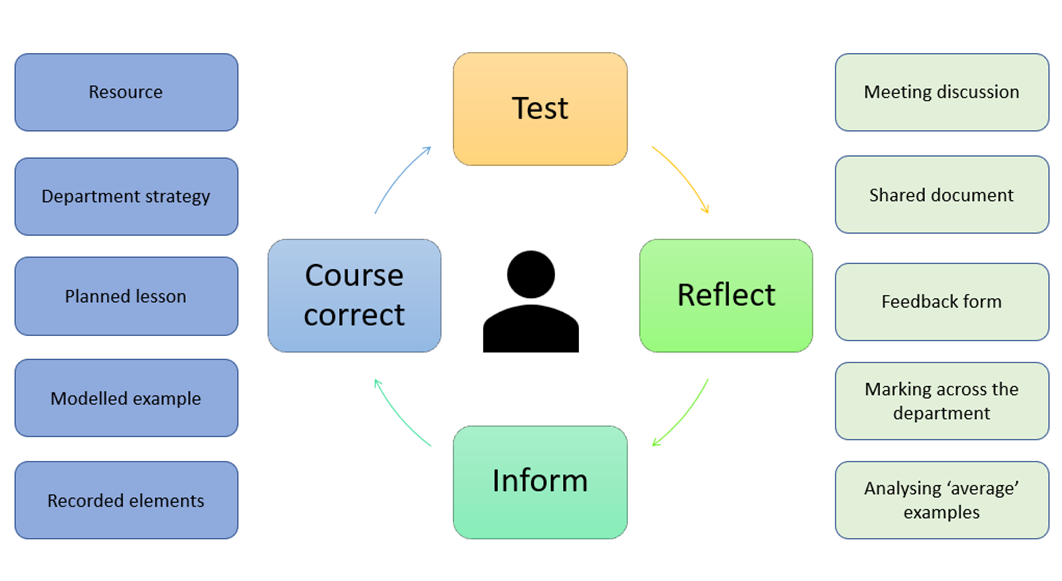
Data is only a small part. For me, there’s a ‘reflect and ‘inform’ part of the process. I build in a lot of opportunities for staff to read, mark and view work across a year group. Most assessments, I ask staff to feedback their findings or we take time to discuss things. We are building that collective identity, They are our Year 7s and not their Year 7s. If we can improve the majority, then we know that there is an impact. As a curriculum leader, I listen and note down and build the picture for staff. We then review it and work on how that will inform what we do. Reflecting is a key part of meetings, but the informing stage is narrowing things down and prioritising. 


Change or improvements don’t have to be massive and big. They just need to be meaningful and effective. And, they need to be done collectively. 


The last reading assessment highlighted that students were not automatically annotating the extract when preparing for the reading questions. Collectively, we are going to model that and build it regularly into the teaching. That’s what we are going to check with the next reading task and assessment. 


There may be discussions at a department level where we decide the order of units. If there is a problem with reading, do we need to move the reading unit next so we can work on that further? The idea is that the curriculum works and models itself to fit, suit and benefit the students.


This process will continue throughout the year as we work on course correction. Long gone are the days when you teach the same thing each year in exactly the same way and in the same style. Curriculums should be reactive and proactive rather than concrete and fixed. 


And next year… 

I think the journey taken in one year should inform the next. The summer term should be an opportunity for departments to look at the order of the next year’s unit and see how it supports or hinders the specific year group. 


If you know writing is a weakness for Year 8, then your curriculum next year should reflect that in Year 9. Moving things about. Changing things. Adding things. 


Next year isn’t a fresh start and a clean slate. It should be building on and supporting improvement. That has largely been a problem with our curriculums. They are fixed on the idea that each new year is a fresh start and new beginning. Those problems in Year 7, 8 and 9 don’t magically heal themselves over the summer. They need picking up again in Term 1 and not after two terms when the teacher spots them.  


My curriculum plan is on one sheet and it is messy. It will always be messy. I’d love to have it beautiful with little pictures, but it needs to change to fit the needs of a year group. That will involve changes all the time. The more you teach a group, the more you understand. 


The Borg in Star Trek are a good model for this. They are constantly evolving and adding and adapting. They search for perfection and that means constantly changing. Yet, they do it together. The problem is that schools place all the emphasis on individual teachers to make big improvements and changes and that is neither fair or easy when you have thirty students and a busy timetable. Problems in schools are collective problems and not individual problems. If spelling is an issue in Year 7, it isn’t one teacher’s job to fix it on their own. The Department should be working on fixing it and not you with a 45 lesson timetable over two weeks. It is the Department’s job to fix it and help.


For too long teaching has placed the emphasis on the teacher to fix and solve. It is their class. It is their problem. Why is it the one teacher’s responsibility when it is a problem across the whole department? 


A problem shared is a problem halved in life. A problem shared is a problem addressed in schools. Be more Borg. Spot, reflect and fix together. Collectively. 


I am Xris; I am Borg. 


Sunday, 7 June 2020

Putting stories back in the curriculum


It is Sunday, so it is hymn number 423:


All things bright and beautiful,

All characters great and small,

All things wise and wonderful,

The writer made them all.


Each little voice that speaks,

Each little person's fling,

The writer made their glowing colours,

The writer made their tiny wings.  


Books. I love them. The short books. The long books. The lost and forgotten books. The cherished books. The unpopular books. The easy books. The complicated books. I love them all.


Annually, there is always a discussion about books in the GCSE English curriculum. Rightly so, we should question and interrogate the choices made. Yet, the discussion on the GCSE texts becomes a hurricane for the whole English curriculum. It pulls in Years 7, 8 and 9 in its path. Everything is forgotten for the sake of the GCSE texts. I know I teach a Shakespeare play, a Dickens novel, a play written by a modern writer and a selection of poems for GCSE, but I also teach other books for the English curriculum. Ideally, those GCSE texts are studied in one specific year. One year. The course might last two, but the time spent on individual books is shorter.


We need a good hard look at how reading is used in the classroom, because I think we are in danger of making the same mistakes as before and just transposing a model from previous exam systems on to the current one.


We are in danger of having book dysmorphia.


We need to re-evaluate how books and stories are used in the classroom, because I think we have become warped into thinking that every book we read in English should be studied and analysed in the way we do books at GCSE. In fact, I’d say that the model for studying books, in English, is the GCSE model. Spend a term on it. Read a bit. Do a bit of work. Repeat again and again. Then an assessment at the end to ensure that the student has a good knowledge of the text.


If we follow the GCSE model of studying books like that (I am still traumatised when I taught ‘Holes’ – that book takes a year to read), then no wonder we don’t read many books in KS3. You are simply blocking off two terms to read one book. We are eking out the interest for weeks at a time. When you look at other things in the curriculum to cover, you can see why people don’t teach several novels in a year.  This is the problem. We need students to read more, yet our curriculum works against this. Instead, we rely on private reading or tutor times to plug the gaps, when we could be looking at our own curriculum to aid this need for more reading and more stories in lessons.


I feel there are two types of book in the English classroom. Don’t think for a second that I being elitist and snobbish about the two types. I view each type of books as equally good and each with their own literary merit. And, yes, you could study them both using the GCSE model. However, I think some books lean closer to analyse and some books lean closer to reading for pleasure / exploration of ideas / issues.


Type 1 – Texts to analyse

Year 7:  ‘A Treasure Island’


Your Type 1 books are meaty, weighty and call for the level of analysis you’d do with GCSE texts. Enjoyment stems from the story and engagement with the language of the text.


Type 2 – Texts to experience as stories  

Year 7: ‘A Monster Calls’


Your Type 2 books are powerful, poignant and need to be read and enjoyed. They don’t need to be stopped and started all the time. Enjoyment stems from the story and engagement with the ideas of the story. They might have an issue or complex emotional conflict.


The predominance of Type 1 books and the associated methodology with them means that the speed, pace and consumption of books is lost. We don’t race through books. We stumble. We limp. No wonder reading has a bad press in teenagers, because if they view reading in the same light as we study books over a term, then I too would be questioning my enjoyment of books. What, before I read this chapter, I have to match up the meanings of words? Books can be just read. Books can be just discussed. Books can be just enjoyed.


Again, our treatment of books follows the GCSE model. We must at some point write on paper something about how language or structure has been used in the novel or we haven’t taught them something. What if the reading of a book and the teaching from it isn’t something you can easily assess? What if it is the culmination of reading several books over several years?


This year, I tried to change the way I used novels in lessons. I looked at how I could change the way we used novels in the classroom. So, I put more texts in. When studying Gothic horror, we read a Real Read version of ‘Dracula’ and discussed the story. Then, we’d carry on with our writing of our Gothic story. No analysis.


Also, at the start or end of the lesson, I’d read a chapter from a book. That book went on for a term or more, but engaged them. They were hooked, and, surprisingly settled at the start or end of a lesson.  They listened. And, they listened. When, I asked them about the story, they could offer ideas and predictions. They were engaged in the story. Oh, and I only needed one copy of the text because I was reading out aloud.


For next year, we are reading with each KS3 class we are aren’t changing our Type 1 texts, but we are adding five Type 2 books. We are adding more story to lessons. Our plan for Year 7 is to read the following:

Ghost Boy – Jewell Parker Rhodes

When Hitler Stole Pink Rabbit – Judith Kerr

Trash – Andy Mulligan

Jessica’s Ghost – Andrew Norriss


We’ll be reading them a bit each lesson. The teacher reading…and the students listening. A collective reading experience. We are putting the story back in lessons. Yes, there might be something interesting about the language or the structure, but the students will hear a story and engage with the story and listen. We are now looking at our Year 8 and Year 9 texts. Why not try to teach students four more books in a year? Do I want the experience students have of a year to be dominated by one book? Plus, if the student’s only experience of reading takes place in the English classroom, then lets give them loads of reading experience. After all, that’s mainly what distinguishes the able and not so able: reading experience. Why don’t we just make the reading experience better for students?


I love stories. Part of the reason I read so much is that I love reading stories and experiencing stories so much. That’s why I read everything and anything. The more exposure to stories, the more chances we have to ignite the spark. Yep, the GCSEs are the goal post, but you can some great passes and tackles before you score the goal.


Reading is the best thing in English lessons. We need to tell each other that is fine to just read the book. It is fine to not have something written in your book after reading. It is fine listen to a story and not be interrogated about the writer’s techniques. It is fine to just read. It is fine. Just read.


Thanks for reading,


Xris

Sunday, 15 September 2019

Google me a lesson!


We live in the age of Google. A time when we can access any knowledge we want, supposedly. We often hear that students need 21st century skills as new technology has made the old ones defunct. The problem is, and most adults know this, that whilst the internet is good for finding small bits of knowledge, like what is the most popular name for a kitten, but it is pretty much useless when finding information about large ideas or nuanced thinking. 


Ask any normal teacher and they’ll tell you that they’ve had an eleventh hour search for a lesson or resource and found nothing. You may hit the odd gold seam, but rarely do you find anything of merit. In fact, you often find a PowerPoint with forty billion slides and each one contains lurid colours and the clip art circa 1990. The Internet has a glut of information and it takes time, not 21st century skills, to find the right information. In fact, it often takes hours.

When you have a few hours a week (or in some cases one hour) to get information and knowledge into the heads of students. An hour ‘researching’ in an ICT lab is dead time. You end up getting students to find the first thing they find and copy and paste that on to a Word document. The academic flavour of your studious exploration of academia becomes a sophisticated exploration of fonts. The colour and the size of the font matters more than the quality of ideas. 


As a teacher, my job is about explaining complex ideas. Whatever text I am teaching will have some level of complexity and I am the puppet master who helps convey that complex information to students. I think the Internet gives teachers, parents and students false confidence. It presents the idea that every crumb is accessible, easy and digestible, yet it largely isn’t. Since the increase in technology, I haven’t since an increase in geniuses. A teacher is needed to help with explanation.  


As teachers, we need to think about what, how and when we introduce ideas and concepts. For my department this year, I have been looking at how we impart knowledge and concepts. For each unit, I have provided a PowerPoint. A very simple PowerPoint.

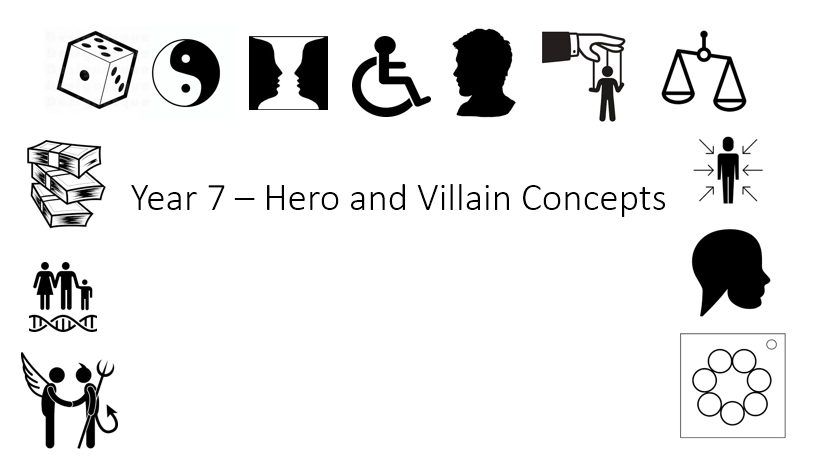
Each PowerPoint contains a list of the concepts / ideas.


And, for every concept there is one page explaining the idea / concept. Just one page. I have thrown some dual coding in for good measure. The main focus is explanation. 


Then, as the teacher is teaching and they feel it is appropriate and relevant for the lesson, they can introduce the concept and idea. The slides contain extracts, pictures, art and text to convey the idea, concept or contextual point.  


The great thing for me is that it so simple and easy to do, but it really helps with planning, pushing to the top and time management. You simply drop the slide into a lesson, when the teacher feels it is relevant and purposeful. This week we explored the use of uncanny in the opening of ‘Rebecca’. I hadn’t planned to explore the uncanny with the text, but it just came to mind, and there was a ready-made PowerPoint slide.


My overall plan is have a huge PowerPoint of all the slides from the various topics, so teachers can call on it when they feel a need arises.  As teachers, we often like planning, but the Google search is often a drain. This way we can cut down time ‘wasted’ hunting for inspiration or a YouTube video that conveys the idea, so the teacher can work on explaining it to the class. 


The great thing for me is that the whole process is organic. I can add slides and concepts as and when they are needed - or thought of. Or, it can build as you are going along. I am currently doing one for Romeo and Juliet and I am on my fifth slide so far. I have even used it for an Ofsted lesson observation last year.  


When reading examiner’s reports, there is a large emphasis on ideas. I think we need to work intelligently on raising the profile of ideas. However, we have to be careful and pick the best moment when to introduce an idea. That’s the problem with readymade schemes of work. They force the points. Ideas are often borne out of something that occurs in a lesson. I feed these through my lessons over a term in no particular order. Some I don’t cover. Some I do. Overall clarity is needed for good explanations. 


Oh, and did I mention how it saves time? 


Thanks for reading, 


Xris 

Here's an example of another unit: 


Sunday, 16 June 2019

Teaching poetry at KS3 – why we need more chat in the classroom.


 When did written assessments become the sole way to mark a student’s understanding of a text, idea or concept? The sad thing is that in an attempt to develop students and praise the God of Progress, we have ditched some useful, handy, and relatively easy, ways to judge an assessment. Instead of getting students to explore texts in depth we are stuck on a pretty limited way of analysis.
Three years ago we ditched all written analysis of poetry at KS3. When students were writing essays about Shakespeare and essays about novels, it becomes tedious when you add another essay or essay style writing. We stopped completely. We, well I, felt that all we were doing was repeating the assessing stage and not repeating the idea forming stage. We were obsessed on the marking rather than the thinking. Were we getting students to think of interesting ideas in the poem? No, we were rewarding those interesting ideas in writing, but were we working heavily students learning the ideas and not necessarily coming up with their own interpretations.
There was another important reason for ditching a written assessment on poetry was the workload problem. At different points in the academic year we have Year 7, 8 and 9 not having a written assessment for a term. This alleviates the pressure points of mock marking. The time when teachers mark mocks is a real pressure point, because suddenly a normal workload is increased by 100%. You’ve not just got a pile of work to mark for each class, but now added to that, because it is the educational equivalent of the Easter Bunny leaving a brown treat, you are left with not just one piece of work to mark but the work like bunnies has replicated themselves several times. So, you are left with four essays per student, because it is ‘fun-time mock season’. That’s why we place the spoken assessments at this point. The last thing you want hanging over your heads is another set of marking, when you have thirty Year 7 essays hanging over your head.
So, how do we use poetry? We have an anthology of poems selected from various times, poets and styles and we link them thematically. Then, we work through the poems one at a time. At the end, we get students to compare two poems and make an interesting comparison. Usually, the talk will comprise of the student selecting two lines from the poems and exploring their ideas and their observations. Finally, we assess the talk for performance (pass / merit / distinction) and then for quality of ideas. We have two levels of assessment. The key thing for us is getting students to talk about poems and explore. And, if I am honest this unit involves lots of annotating and lots of talking. Talking is good. Talking is great. Talking is easy. We talk about relationships in Year 7. We talk about voices in Year 8. We talk about setting in Year 9.
For me, the emphasis on raising the quality of discussion is far more productive than the identikit written analysis we were doing before and I talking too of the awful APP units too. We talk before we write. And boy isn’t that the problem with KS3. We write before we talk. ‘Write down your idea before we share it,’ is a phrase often said. Our emphasis is on the written communication. The forming of sentences. The capturing of thoughts on a page. How many teachers fear having a blank page in exercise books at the end of the lesson? 
Ideas need space to form, develop and grown and that happens verbally. One of the things I often say to students is the need to talk in English. Argue. Chat. Disagree. Question. Challenge. Persuade. If a student can talk about something, they can sure as hell write about it. I love being challenged. I had a lengthy debate with one student over the colour of the lighting in An Inspector Calls. He was challenging me and I loved it. I even went to Twitter to seek support. He apparently did a poll with the students on another social media platform. Some might call it a ‘spark of interest’. Another might call it ‘engagement’. I’d call it the exploration of an idea.    
Boys can cope with challenging and complex texts, but has the process of how we do things had a negative impact?  I was that loud mouthed boy at secondary school. I’d talk about anything and everything. Get me involved in a conversation and I was hooked. Give me something at that age and ask me to write about it and I would struggle. I’d struggle because I hadn’t bounced the idea around in my mouth and in the air around me. I hadn’t heard the sound of ideas and heard that one thing sound better than another thing else I had said.  
Again, the problem is the nasty loathsome GCSEs spoiling everything. Because there is a large unseen element of the exams, we have internalised that exam process in planning ideas for lessons. We give students a task and expect them to treat it like an unseen text. Think of an idea on your own and write it down. We don’t go and get them to talk about it first. This process is repeated endlessly in lessons and classrooms. We know boy’s engagement is an issue, but is that engagement something simple like the use of communication skills? Is it our emphasis on writing that is hindering boys’ ability to communicate? We talk about looking for the quick fixes, but could it be as simple case of us using the writing process as the dominant way in rather than the spoken process. We spend half our time telling boys to be quiet, when maybe that should be the thing that we promote. Talk boys, but make sure it is about what we are focusing on in lessons.
Now, I am not advocating people get debates and formal discussions in lessons. In fact, far from it. A debate is probably the last thing we need. I do, however, think we need to explore how we use chat and discussion in lessons. How could we use it to engage students with the ideas, content and texts? Are we turning everything into writing? Do we want English to be the subject that is solely known for writing? Wouldn’t it be better if English was the subject where students felt they thought about things?
Right, here is one such thing I did with some poetry. I revealed the poem ‘Stealing’ by Carol Ann Duffy one line at a time. I then gave students this grid. 

Deeper meaning

·         I think the poem is really saying…
·         For me, the poem is teaching us…
·         On the surface the poem is about … but under the surface it is about…  


Comparing to the other poems

·         This poem is a bit like …because… 
·         The poem is the opposite of … because ..
·         I think this poem shows an alternative perspective to …
·         This poem focuses more on … than

Pick on a word and explore

·         The word ‘…’makes me imagine…
·         The word ‘…’ makes me think of …
·         The word ‘...’ reminds me of...
·         The word ‘…’ make me feel …

Feelings

·         To make us feel _________, the writer shows us…
·         To make us feel _________, the writer uses the image of …
·         To make us feel _________, the writer uses the combination of …. and …


Symbols

·         The writer uses …. to be a symbol of...
·         …. is usually a symbol of … but here it is used as a symbol of…
·         … is symbolic of the relationship between … and …

Connections between aspects in the text

·         The use of … and … makes us…
·         There is a pattern of … across the text…
·         The writer seems to be repeating…

An alternative way of looking at things

·         Another way to look it is …
·         It could also suggest…
·         Someone else might think that…


Developing / Increasing / Decreasing

·         As the poem develops, the …. increases because …. 
·         There’s a marked decrease in … as the poem progresses
·         I notice that … develops in the poem
Changes

·         The mood changes when…
·         The writer changes the tone of the voice when...
·         The turning point in the pome is when…
Students had to share ideas and explore the poem using the sentence openings. Each time they shared one with the class they ticked it off. I didn’t get through the poem. In fact, I only made it to the second stanza with them. The discussion was relentless. I had boys exploring how the snowman might be a metaphor for a man dehumanising a body after killing a person. Another, kept seeing patterns in the words. Another spotted subtle changes in the tone. We, together, explored the choice of taking the head first, exploring the fear of eyes looking at the stealer / murderer.
Did all the boys contribute? No. Did all the girls contribute? No. The majority did. A few didn’t. And that’s simply because not everybody is the same. These students, and I know them to, would prefer to write their ideas down rather than share them with the class. Some of these students like to absorb the ideas and then come to their own idea as result of hearing the others talk. Next lesson, we’ll see what they come up with.
There is no one model that fits and suits all students, but do we have a model for teaching that hinders a part of the school population. Balance is key. Maybe the balance has been shifted too far one way. If I asked those students to write about the poem, they’d do so with aplomb. That process is needed to help them get to a point of independence. KS3 isn’t the wasted years. It is the idea forming years. We need it to be a time for forming ideas. And that starts with talk.

In the beginning, I learnt to talk and I did that before I started to learn to write. Before all writing, there comes talk.

Thanks for reading,

Xris

Sunday, 7 April 2019

What can English learn from Maths? Skills Checks.


Recently, I have been jealous of how Maths have a plethora or targeted resources on specific questions. I have seen endless examples of different types of questions and looked on with envy. The problem with English is that we are often teaching different texts or the needs of our children are different. One teacher might have problems with students learning quotations, when another teacher has a problem with students not explaining things enough in their writing. Therefore, when looking at resources, we are often quick to save or ignore them. That resource will not solve my problem. Nice idea, but it will not help me.

One resource in Maths has inspired me in English. It’s a simple resource and I apologise for not finding the original source. It features either a small A5 sheet of paper or one PowerPoint slide. On it are five or six different mathematical problems. Each one tackles a different skill or thought process. Often, it is used as a starter or as a task on its own.

I liked it because it addresses several things at once. It identifies gaps and it helps to reinforce learning from previous lessons. Furthermore, it allows teachers to address gaps in the learning or address misunderstandings. I kept thinking: why don’t we have something like this in English?

Often our problem in English is that our teaching is dependent on identified needs rather than routine learning. We set a task and then on the back of that task we adapted our teaching to address the weaknesses. Their spelling is terrible, so let’s spend a few weeks on spelling. Their grammar is weak, so let’s have a weekly grammar lesson. Their comma usage is terrible, so let’s have a lesson on commas. They are quick course corrections, but do they fundamentally change the students approach to learning?  One lesson. One week. That one term has a lot of pressure on it to be a magical cure for misunderstandings. 

The problem isn’t necessary when we teach the aspect but how often and how regularly we visit the area. We teach when there is a need and not with an expectation that it is a need or a basic foundation in English that needs constant revision, reminding and reteaching.

We know students are going to spell words incorrectly. We know students are going to use commas incorrectly. We know students will struggle with apostrophes. Why are we not looking at them weekly?

Therefore, I have adapted the grid for English and used it with several groups with success. It takes ten minutes to make and I can use it with every year group.  I don’t need to photocopy it sometimes and simply use a PowerPoint slide and students complete the work in their books. In fact, if one person in the department makes one sheet, you’d have enough for a whole term.


I tend to start the lesson with these sheets. Students spend five minutes completing the different tasks and then we work through the answers as a class. So far, I have done this once a week and it has been quite effective and helpful. I can easily tailor the boxes so that I can put emphasis on things, but also go to areas that haven’t been explored for some time.

It is also great for reinforcing rules. We have, like others, a problem with comma splices so I’ve made sure that I am working weekly on comma splices. Reminding students of rules to spot and fix a comma splice. Rather than spend one lesson on comma splices, I am spending 3 minutes a week all year.  I am revisiting and reteaching all the time. Why spend a whole lesson planning and teaching on it if you can do it weekly?  

Our newfound emphasis on curriculum has made us re-evaluate things. The SPaG or grammar lesson always troubled me as a concepts as it was viewed separately from the core of English learning. This approach allows for grammar to be integrated and common within lessons. It doesn’t have to be a distant cousin.

What if each teacher made one of these and shared it?

Thanks for reading,

Xris