When did knowledge become such a dirty word? For some subjects, it isn’t a dirty word. In fact, it is the bread and butter of lessons. Go to any Science or Maths lesson and you’ll see what I mean. Yet, for creative subjects, like English, it has become a word associated around Gradgrind principles and sucking out the fun out of lessons and learning. Oh, you are one of those knowledgy teachers: I bet students hate your subject. Popular belief would have it that knowledge is one arm of Hydra’s plot to take over the world. Other conspiracy theories are available.
A teacher’s job is to teach knowledge with the aim to
improve the student. That might be knowledge behind a skill. That might be
content knowledge. That might be subject domain knowledge. Like sand from a
beach, knowledge is everywhere. You can’t escape it. Like sand from a beach. I
might be wearing my creativity speedos, but you can guarantee there will be a
grain of sand somewhere.
My first year of teaching was awful. I meandered from topic
to topic and the knowledge in English I was teaching wasn’t focused and, at
best, it can be described as meandering. I meandered through writing to
persuade and I meandered through some poems. Yes, I might have done some interesting
things with the topic and I taught them some interesting things about pikes,
but I meandered. When I started teaching English, there was a lot of freedom,
but also a lack of clarity about what knowledge was important and what wasn’t
so important. That is also the problem we have with new teachers today. It is
so difficult to work out the knowledge needed. And the hierarchy of knowledge.
English does work differently in terms of knowledge compared
to other subjects. Its fuzziness is one its flaws but also its source of beauty
and delight. Maths can hone their knowledge into 100 key facts. English can’t
do that so easily. I could give you a 100 key facts about A Christmas Carol. Or,
I could give you 100 key facts about Romeo and Juliet. But, what I cannot give you,
is 100 key facts that students need to know for English. That’s because English
is such a fuzzy subject. We are doing so many things that we cannot limit
knowledge, because English is the limitless knowledge subject. It has no limits.
In lessons, I could be talking about a text and then I have to break out into
some teaching about Science, History, Geography or another subjects. I might teach
English, but I have to be prepared to teach aspects of History at any given
moment. Only this week, I had a lesson broken by a student’s train of thought
about animals. They wanted to know what prevents animals getting tooth decay if
they eat lots of fruit. English lessons are a delta of knowledge. We go
anywhere in a lesson and we are taken on that path. It is also why English lessons get changed and adapted so quickly and often. No two lessons are ever the same
in English, because students bring something of their own to lessons. That
might either be a lack of knowledge or their own knowledge. Either way dictates
the direction of the lesson.
English is the one subject that doesn’t work like others in
terms of knowledge. I will scream from the top of the mountains that last
sentence. I don’t mean it in terms of ‘look at us; aren’t we special’ but in terms
that our subject has a real problem with adopting knowledge models from other
subjects. We could easily simplify English to 100 key facts, but that wouldn’t
help them in exams. In fact, it would be so damaging, because students, in
English, need 100( to the power of 100) number of facts to address the unseen
elements of exam. They need world knowledge. They need spelling knowledge. They
need sentence knowledge. They need grammar knowledge. They need past reading knowledge.
They need situation knowledge. They need word knowledge. You get the drift. A
student brings so much to a text in English. They are suitcases of knowledge and
with the suitcases’ contents they
formulate an idea, an opinion, a judgement or an inference.
Knowledge in English isn’t a dirty word in English, but our
relationship with knowledge needs some work. We need a healthy relationship with
knowledge and a realistic view of it in our subject. English tests all knowledge regularly
but how do we support that in lessons?
We have been trying something to build that healthy attitude
towards knowledge. Last year, we had a disaster of introducing knowledge retrieval
in KS3. In my naivety, I thought it would be great to do three low impact
knowledge tests in a unit. It wasn’t great. One at the start. One in the middle.
One at the end. What could go wrong? Everything. We are testing too much and
without meaning. The logic behind was to show improvement in knowledge
retention, but it was soulless, meaningless and vapid.
This year, we’ve thought about how we can use knowledge
assessments meaningfully that works with the subject and not against it. We
have separated them into three elements – memory sparks, memory makers, memory
tests. Each one takes a lesson but there is a clear purpose behind the phases.
Memory Spark
At the start of all units, we have a small quiz which
focuses on some of the knowledge taught in previous years we think it relevant to
the topic in some way. Our curriculum has a through line for topics and they
link back to previous years. For Year 7, we make connections to primary content
and the primary curriculum.
The great thing about this is that builds the message that
all learning is important. The new topic doesn’t negate all the things taught
previously. The new topic isn’t starting with a blank slate. The knowledge is
connected from the start. Remember when you explored character types, well,
that links to this bit.

There’s no collection of scores or even test element. We’ll
assume that some things will be forgotten, but it gives us a chance to review
what’s be retained, what’s be forgotten and what’s been corrupted and
misinterpreted over time.
Memory Maker
In the middle of the unit, we have another quiz, but this
time it about building more links across domains. At this point in the unit,
students have got a grasp of the key ideas and so it is perfect time to build
on those connections.

Building connections is an important aspect of English. We
are expecting students to build connections between factual knowledge in an exam
so we need to get students searching for meaningful connections. Experts do
this naturally and novices don’t. We had such an interesting discussion with Year
7 about the portrayal of the warden in ‘Holes’ and the various books they read
when exploring character types in our ‘Heroes and Villains’ unit. That built up
their understanding and showed that their previous knowledge and experience is
redundant. In English, all knowledge and experience is valuable; you just don’t
know when it will be called into action. And, there lies our biggest problem.
This, for me, was the most interesting and fun aspect,
building connections. We rarely do it, but it was fun for me. Getting them to
make and build connections across subjects. All too often, it is relying on me
making connections or the odd student offering a connection.
Test
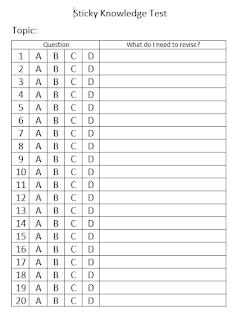
The final aspect was a multiple choice quiz. Using a
PowerPoint and a sheet, students had to answer the questions on a grid. Yes, we
marked it and students had a score, but the most important thing was where
students got things wrong. So, for the bits they didn’t get right, the wrote
down the key thing they needed to know. That will be their starting point for
their end of year test. After each topic, they have a list of things they need
to work on.
The great thing about using PowerPoints for MCQ is that I am
able to use the slides for hinge questions later in the year. Also, I am able
to build them into the topic next year – especially the parts that they
struggled with.

The test becomes more of a diagnostic tool and we identify the knowledge they need to work on.
We, of course, do other things with knowledge but this is
what we’ve done in KS3 to help structure knowledge focus. We do knowledge
retrieval on a regular basis, but this is how we use systems to support and
raise the profile of knowledge in the subject. It works on three main
principles:
[1] Past knowledge is equally as important as the present
knowledge;
[2] Connecting knowledge is an important aspect of English;
[3] Quizzing and testing help to revise forgotten knowledge and
identify areas to focus on.
For the rest of the lessons, we are reading novels, plays
and poems and writing creatively. The natural flow of creativity and knowledge
attrition through reading and experiencing texts continues to happen. We just
have a visible discussion about knowledge every so often. Knowledge is part of the
discussion and learning. It isn’t about learning things by rote or cramming
students with hundreds of spurious facts. It is about having a academic,
thoughtful and humane approach to English. Each lesson has knowledge. We just
do it a little bit differently than how others do it in their subject.
In English, we teach students to think and read how others
think. That sadly is hard for the rest of the world to quantify and clarify. English
is the subject with endless knowledge. Be my guest, try to quantify and clarify
English as a subject, but there’s a reason why there are hundreds of novels and
books written a year. There’s a reason why dictionaries are updated yearly. You
cannot pin down language, thoughts, feelings and experiences. You can pin a few
down, but you cannot pin every single one down and fit it on a knowledge organiser.
Thank you for reading,
Xris
